Sauter au contenu principal
actuellecd

Blogue

188 résultats
  • 6
  • 7
  • 8
  • 9
  • 10
  • 11
  • 12
  • 13
  • 14
  • Érick d’Orion, David Turgeon, No Type dans Le Devoir

    «La communauté No Type», David Cantin, Le Devoir, 6 septembre 2003
    samedi 6 septembre 2003 Presse

    Depuis deux ans, l’étiquette montréalaise No Type (affiliée au site Internet www.notype.com) affiche une croissance rapide et judicieuse. Avant la fin 2003, on parle déjà d’atteindre la quinzième parution dans le créneau assez vaste des musiques électroniques. Après un passage remarqué au festival Mutek au printemps, la nouvelle saison s’annonce d’ailleurs plus prometteuse que jamais. Cette semaine, l’album Bleak 1999 du Canadien Tomas Jirku arrive chez les disquaires au même moment que l’electronica délinquante et peu orthodoxe de Books on Tape.

    Depuis les débuts du site, en 1998, on prône chez No Type une liberté artistique foisonnante. Toutefois, selon David Turgeon, le fondateur du label, il s’agit de bâtir un catalogue qui s’appuie sur une cohérence nécessaire. «On constate que deux lignes directrices s’imposent au fil des sorties. Il existe une certaine dualité entre les recherches assez expérimentales de Coin Gutter, par exemple, et une électronique IDM plus accessible comme celle de Headphone Science. On souhaite que ces choix se précisent encore davantage avec le temps.» Il faut peut-être savoir que No Type a aussi beaucoup contribué à l’éclosion d’artistes fort importants tels Tomas Jirku ou encore l’énigmatique Claudia Bonarelli. D’ailleurs, le click-house de Jirku est d’abord apparu sur le site de cette communauté musicale avant d’atterrir chez Alien8 (Substractif), Intr_version, Force Inc ou Onitor.

    Comme l’indique son titre, Bleak 1999 date de 1999, alors que Jirku pratiquait un minimalisme sombre et mélodique. Proche de son travail sous le nom de The Viceroy, cet album déstabilise grâce à des atmosphères aussi étranges qu’irréelles.

    «On a affaire à une réalisation plus crue et directe, commente Turgeon, sans détours ou traitements inutiles, qui surprend par sa vélocité singulière. À mon avis, cet album-concept a très bien vieilli même s’il se détache du travail actuel de Tomas [l’excellent Plusism avec sa comparse Robin Judge]. Même s’il a la chance de sortir des CD sur des étiquettes aussi prestigieuses que Force Inc. en Allemagne, Tomas est toujours resté en contact étroit avec No Type. On demeure donc très heureux de pouvoir enfin lancer Bleak 1999.» Après sa prestation, la semaine dernière à Montréal, avec The Unireverse et DJ Tobias, Jirku, désormais installé à Vancouver, entreprend une tournée de deux mois qui le mènera en Europe et au Japon.

    Parallèlement à cette sortie, No Type récidive avec le deuxième album de l’Américain Todd Drootin (mieux connu sous le pseudonyme Books on Tape). Membre du duo noise morceaux_de_machines, Érick d’Orion parle de Sings the Blues comme d’un ensemble de pièces qui pourrait surprendre les gens qui ne s’intéressent pas habituellement à l’électronique. «Todd fait partie de cette mouvance d’artistes électroniques qui proviennent du rock indépendant. C’est frais et intense. Il s’amuse à mêler les rythmes d’une manière très inattendue. Il remercie d’ailleurs sur son album des artistes aussi différents que Sonic Youth, Timbaland, Sun Ra et Lee ‘Scratch’ Perry.» Le disque sortira même aux États-Unis chez Greyday, puis il sera possible de voir Books on Tape en spectacle au début novembre à Montréal avec la formation électro-punk française Métal Urbain.

    Dans les projets à venir pour No Type, David Turgeon mentionne des nouveautés à venir de la part du duo inclassable Front, des Italiens de Metaxu, des très bruyants morceaux_de_machines et du glitch abstrait de 833-345, de même que son propre projet sous le nom de Camp. Pour en connaître davantage sur ce label imprévisible, on recommande de visiter le site www.notype.com, où différents albums sont disponibles en ligne.

    … on prône chez No Type une liberté artistique foisonnante.

    Montréal Free dans Exclaim!

    «Reviews — Improv & Avant-Garde», Eric Hill, Exclaim!, 3 septembre 2003
    mercredi 3 septembre 2003 Presse

    No Type presents a four-CD set featuring four free jazz ensembles from a scene centred at Montréal’s Casa Del Popolo. Two elements that immediately impress about these groups is a prevalence of electric guitar, an instrument not widely used in free jazz. Secondly is a marked absence of any electronics whatsoever in a time where most new jazz seems to put electronic elements centre stage. ’Gypt Gore is the duo of saxophonist Philémon and Sam Shalabi on guitar. Both play their instruments with a restless energy bordering on attention deficit disorder, occasionally rising to the point of eruption into angry beehives of noise. The fiercest and largest of the ensembles is Balai Mecanique, a sextet that includes the duo from ’Gypt Gore plus Thierry Amar. Unlike some larger groups they are not “led” by a specific member, making the directions taken and changes made much more spontaneous. The changes within the undulating chaos are deceptively subtle. PO (or “Provocative Operations”) is a quartet featuring Mr. Shalabi for a third time, as well as Rainer Wiens on electric guitar. Wiens is a 15-year veteran of the jazz scene and has truckloads of tricks and treats to splinter the guitar’s usual sound. John Heward and Alexandre St-Onge round things out on drums and bass; their music is the most delicate and introspective of the lot, featuring much more air and space surrounding each note, but also the most daring in terms of improvisation. Finally there is the trio of Chris Burns, Nicolas Caloia and John Heward (trio Presence). Chris Burns’s guitar is more subdued and classic, playing full chords rather than picking notes and generating noise, but also perceptively detached from the bass and drums of the other players. Each of the three musicians often picks their own course and seems to cross paths only occasionally and accidentally at that.

    Télépathie dans KindaMuzik

    «Kritiek», Joris Heemskerk, KindaMuzik, 1 septembre 2003
    lundi 1 septembre 2003 Presse

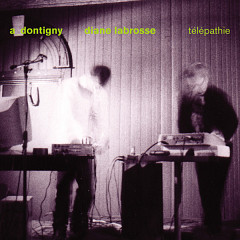
    Dit is een fijn staaltje live opgenomen noise-improvisatie. A_Dontigny (Aimé Dontigny) free noised al een tijdje met zijn speeltjes Napalm Jazz en Morceaux_de_machines. Diane Labrosse is een liefhebster van abstracte noise en samples. In de avantrockkringen maakte ze eerder deel uit van de Wonderbrass en Justine. Arty rock met een duidelijk aanwezige feministische inslag. Van dat feministische is gelukkig niks te horen op Télépathie. Beide artiesten laten zich lekker gaan achter een computer en sampler om zo heerlijk abstracte noisecomposities te brengen.

    Zoals het bij een live-voorstelling hoort wordt de spanning langzaam opgebouwd. Langs opborrelende white noise-bellen en filmische, felle geluidsfragmenten op t.s.f. naar de steeds intenser wordende noisevlakken van photo satellite. Als de maximale intensiteitsfactor wordt gehaald, schakelen de twee terug om zo weer te beginnen met het creëren van een nieuw spanningsveld. Langzaam maar zeker komt photo satellite weer op gang met een langgerekte toon die wordt onderbroken door steeds sterker wordende noisewindvlagen.

    média tactique start met een een Frans gedicht van Denis Vanier, op de achtergrond onheilspellende ruis en verstorende mokerslagsamples. De stem vervaagt en een storm van fluitende noise steekt op. De wirwar van lawaai gaat over in een zowaar herkenbaar noiseritme waarmee de live voorstelling en daarmee ook dit album eindigt. De storm die je eigenlijk al aan zag komen heeft je toch verrast. Ik ben benieuwd wat No Type nog meer met deze twee van plan is.

    Montréal Free dans e/i magazine

    «Review», Marc S Tucker, e/i magazine, no 2, 1 septembre 2003
    lundi 1 septembre 2003 Presse

    Ostensibly a showcase for a quartet of groups, this 4-CD ‘box’ is actually a rostrum for Sam Shalabi (better known in the eponymous and justly lauded Shalabi Effect) and friends. It’s also ostensibly ‘free jazz’, as far as that tired old sobriquet will go, though ‘free music’ would probably be more apt, but suspicious. Even more to the impalpable point, the first CD documents the Po foursome, wherein the far fringes of a transmutational psychedelic consciousness invade the proceedings, so what we open with is an organic free interplay effort somewhat akin to portions of old Amon Duul II anarchy. With two guitars and a drumset capturing the front stage, what’s actually of seminal import is Alexandre St-Onge’s undercurrent contrabass work, the very plasma of each song, where and when it occurs. Feedback supplies surrogate keyboards and the group pays close attention to every shift in dynamics, thus this isn’t a completely random affair by any means. One merely need pay attention to follow the lines. The ’Gypt Gore disc dives straight into Philémon’s gabbling sax, with Shalabi tweedling his axe like an undistorted James Ulmer, both scampering for rabbit holes and skyhooks, jetting off in seven directions at once. Five of the nine tunes feature the pair racing through surprisingly coherent colloquy, not at all the disparate individual self-indulgences that might be expected, the otherfourfeature either Thierry Amar, bassist, bringing a more fidelitous mainstream taste into contrastive play, or a second guitarist. Stymie Stime is of immediate interest, as it pays tribute to and mocks rock and fusion guitarwork. Again, in each selection, a concentrated listen reveals the subtleties of intercourse within the duet. The Burns, Caloia, and Heward Trio populates the third disc and comes the closest to recognizable forms, but their deviational twist is what makes the seven cuts attractive. The trio, like ’Gypt Gore, breaks down fusion (little of this could be called jazz) with some reverence and a lot of sloppy grace but also a knowing grin, slowing it way down and presenting the measures in connected packets, seasoned with lightly scattered noise, though some cuts are pure sound generation and just as fetching. In sum, a lazy quaalude reverse-dithyramb for zoned essences. Balai Mécanique, a sixheaded hydra, closes out the set in riotous Trummerflora-ish fashion, a convocation of Jovians down for a weekend freak-and-gossip session. Four long songs, and three very short ones, give the visitants all the room they need to ramble, argue, hght, philosophize and loll about, which they do with uninhibited abandon. The most noticeable vibe to this is its collective nature, more intense and much thicker than the mating discs. Saving it as the final installment was a good choice; the listener (and the critic) exeunts flushed and sated.

    … not at all the disparate individual self-indulgences that might be expected…
  • 6
  • 7
  • 8
  • 9
  • 10
  • 11
  • 12
  • 13
  • 14