Sauter au contenu principal
actuellecd

Blogue

179 résultats
  • 16
  • 17
  • 18
  • 19
  • 20
  • 21
  • 22
  • 23
  • 24
  • Alexandre St-Onge, Ambiances Magnétiques dans AllMusic

    «Portrait: Alexandre St-Onge», François Couture, AllMusic, 1 juin 2002
    samedi 1 juin 2002 Presse

    Alexandre St-Onge is an ambiguous artist from Montréal. He started playing free jazz on double bass and quickly developed into a sound/performance artist. He belongs to the generation of experimentalists and improvisors that came after the Ambiances Magnétiques collective and was actually instrumental in establishing some contacts between that group of artists and the younger ones revolving around Godspeed You Black Emperor! He has released a few solo albums and recorded and performed with Klaxon Gueule, Undo, Et Sans and Shalabi Effect.

    St-Onge studied double bass. Little is known of his formative years, but his first major musical activity was being recruited by Ambiances Magnétiques drummer Michel F Côté to form the free improv trio Klaxon Gueule (also with Bernard Falaise). A first album, Bavards, came out in 1997 on which St-Onge performs in a classic American free jazz style. By the time the group’s second CD Muets was released two years later he had abandoned conventional playing, focusing on effects, electronics and textures, dragging the formation into European-style electro-acoustic improv.

    In the meantime the bassist had met the other, mostly anglophone Montréal avant-garde scene, collaborating with the likes of Sam Shalabi (in his Shalabi Effect with albums out on Alien8 Recordings), David Kristian (the trio Kristian Shalabi St-Onge, also on Alien8), and conceptual artist Christof Migone, once of the Quebec sound art collective Avatar. St-Onge released a first solo album, Image/Négation in early 1999. It established his fondness for the exploration of silence and noise, relating his work to artists like Francisco López, John Duncan, Bernhard Günter and John Hudak.

    On his second solo effort, Une mâchoire et deux trous (1999, Namskeio) he built eery textures by putting contact microphones in his mouth. This idea was developed into a performance art concept with Migone in the duo Undo. The pair also founded the record label Squint Fucker Press in 2001. Meanwhile St-Onge reached a certain level of success with the avant-psychedelic outfit Shalabi Effect. He also recorded an album with Godspeed You Black Emperor!’s Roger Tellier-Craig as Et Sans.

    Bernard Falaise, Ambiances Magnétiques dans AllMusic

    «Portrait: Bernard Falaise», François Couture, AllMusic, 1 juin 2002
    samedi 1 juin 2002 Presse

    A Montréal native, where he is still based, guitarist Bernard Falaise exploded on the new music scene in the late ’90s, appearing in many Ambiances Magnétiques-related outfits, especially in avant-rock oriented groups that included drummer Rémi Leclerc (Miriodor, Les Projectionnistes, Papa Boa). He is also active on the free improv scene, playing with Klaxon Gueule and Robert Marcel Lepage among others. His distinctive guitar style, at times raw and twangy, at others highly atmospheric, set him apart in the same class of originals as René Lussier. He is also a much in-demand record producer and has composed contemporary classical music in his spare time for the tango ensemble Quartango and the saxophone quartet Quasar.

    Falaise was born in 1965. Little is known from his formative years. He picked up the guitar in his teens and came to music from the progressive side of rock — King Crimson’s Robert Fripp is an obvious influence. He studied music and started to work professionally in the early 1990s, joining the avant-prog group Miriodor. The group’s fourth album, Jongleries Élastiques, came out in 1995 and introduced his playing to fans of the genre. The enthusiastic response to the album ensured he was dutifully acknowledged for his important contribution to the group’s refreshed sound.

    Miriodor drummer Rémi Leclerc was already well acquainted with the avant-garde music collective Ambiances Magnétiques and he introduced his friend. Falaise quickly became a favorite sideman and enrolled in Claude St-Jean’s Les Projectionnistes, Michel F Côté’s Klaxon Gueule, Duchesne’s Diesel (sadly undocumented), and started the group Papa Boa with Leclerc, saxophonist Pierre Labbé and bassist Frédéric Roverselli.

    In 1999-2000 Falaise diversified his activities, reaching a wider audience. He co-wrote with Côté the music for Robert Lepage’s film “Nô” and began to work with alternative pop artists. He co-produced the first album by Jorane in 1999 and the next year produced and played on Marie-Jo Thério’s acclaimed CD “La Maline.” The number of awards and praise this album gathered assured him a first-class status as cutting-edge producer. In the meantime he released his first solo CD, Do, a collection of multi-tracked guitar pieces.

    His distinctive guitar style, at times raw and twangy, at others highly atmospheric, set him apart…

    La spirale de l’escargot, Ipso Facto dans Voir

    «Critique», Nicolas Houle, Voir, 30 mai 2002
    jeudi 30 mai 2002 Presse

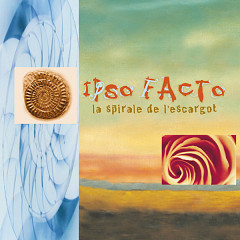
    Premier album du quatuor Ipso Facto, La spirale de l’escargot regroupe une douzaine de pièces instrumentales qui se veulent autant d’incursions en territoire world. Avec une rigueur d’écriture évidente et une légère touche d’improvisation, la troupe s’essaie autant au klezmer qu’au reggae ou aux musiques latines. Faisant la part belle au violon de Chantal Bergeron, les titres mettent également en relief les guitares acoustiques de David Bussières, la contrebasse sobre de Simon Dolan et les percussions discrètes de Francis Roberge. Bien qu’un peu trop guindé et n’exploitant pas toujours les maintes possibilités du quartet, La spirale de l’escargot compte de bons moments. À rapprocher, dans un format moins complexe et moins hyperactif, des plus récentes élucubrations de Volapük.

    … une rigueur d’écriture évidente et une légère touche d’improvisation…

    liberum arbitrium, morceaux_de_machines dans Ampersand Etcetera

    «Review», Jeremy Keens, Ampersand Etcetera, no 2002_7, 20 mai 2002
    lundi 20 mai 2002 Presse

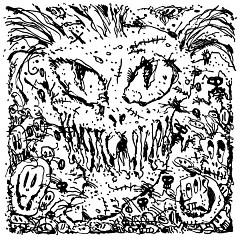
    The evil face embedded in the doodlish ghoulish cover illustration by Guy Boutin juxtaposed with Sophie Dowse gentle watercolours on the inner sleeve is somewhat suggestive of direction, and is furthered by the Anthony Burgess quote (which is the only part of the extensive liner notes in English) about “two kingdoms… the eternal and luminous one of the divine lord’s own making, and the noisome stinking pit of pain and horror… of god’s enemy.” Within those notes “fragilité… construction de tension… danger… source des textures” all support the impression gained from the cover and delivered by the music.

    Aimé Dontigny and Érick d’Orion, morceaux_de_machines, create some of the hardest ambient-noise I’ve heard recently, teetering between the pit of despond and the beautiful city. I thought cut-up would be the end of me – there is an on-going click-pop “melody” which sounds like the soundtrack to a sci-fi battle with choppy cd/tape samples below (either some rap of just aggressive people). As it continues, there is a surprising melodic aspect and a shattered stability. The disconcert continues in multivisión espacial with more rapid pops shoots bloops plips and more over samples, which sound like jazz with guitar flute etc. As time passes the aural assault continues, sharp needles of sounds, more noises, and eventually the surface noises become a merged buzz of sounds, brief dropouts, voices in there, to a quieter final minute.

    When you think it will all be overwhelming, lo-fi soundscape eases the impact a little, with lighter whizzy surfaces over piano and sax, again easing to a quieter end. Or spencer’s percussive bursts melded with loose-cable crackle, all echoed slower and quite visceral. Voice pulses enter, it builds and distorts, and then there is a reverbed voice briefly talking to us (an unexpected directness) before a big layered end. And we are caught quite unaware by the lightness of prime shake: gentle pips and burrs, like a computer control room, soft rhythms and crackles, a distant tone melody: the crackle builds, it is all dense restraint into a percussive end.

    métal scrap is well named as a scraping melody weaves through crackles drums and building noises over a soft solid bed, joined by a voice – possibly Hitler or a Dada-esque speech, hard to say – solid and directed. The squeaks clicks and soft tone pulses that open rothko are almost pastoral, electro-frogs, a slow echo-drum running through and slight increased density and pace, the samply-jump behind providing subtle noise, a little more desperate to the end before a crackle-pop fade. The final track digisex swings back to the more oppositional strategy, here a degraded distant pop sample provides some vocals and a rhythm, the bleeps and peeps over increase, subsumed by a soft and rumbly futz – a sort of bolero – and all breaks down again in the last minutes.

    The beginning of this album threw me onto the back foot, and seemed all noise and aggression, but as I listened through it and on replay I actually warmed to it. m_d_m do achieve the straddling of the inferno and paradise suggested in the notes, creating a surprising and satisfying combination of electro-noise with subtler elements weaving through. Intriguing.

    morceaux_de_machines create some of the hardest ambient-noise I’ve heard recently… a surprising and satisfying combination of electro-noise with subtler elements weaving through. Intriguing.

    Chemin de fer, Magali Babin dans Ampersand Etcetera

    «Review», Jeremy Keens, Ampersand Etcetera, no 2002_7, 20 mai 2002
    lundi 20 mai 2002 Presse

    Following the No Type compilation, three new disks from the real world collaboration between David Turgeon and DIFFUSION i MéDIA arrived at Ampersand Etc.

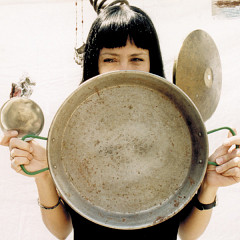
    Magali Babin improvises her sounds on “metallic instruments and objects, which [she has] made, recycled or reinvented,” which go beyond the tin things pictured on the cover, as the notes also mention “a rather small electrical object… guitar pick up,” the mike placement has also had an important impact, as has “the studio work.” However, created originally for a radio show, the pieces here demonstrate the range of her constructions.

    It opens with a more tentative, less structured piece that like many improv albums, tests the listener straight off. Triturations is an amalgam of shimmers pops scrapes twangs voicey-noises shakes subtleties and crackles that twists and changes adding thuds and winds in a complex electroacoustic weave of sounds of unusual colour and timbre. Petit jardin is more straightforward, alternating periods of a strumming with the sound of pebbles dropped in a bowl, with an overall chime, adding a scooping sound near the end. With my french, La corde is appropriately named – scraping and some plucking of a stretched wire accompanied by a percussive thud that sometimes sounds like a ruler being twanged. Monsieur et madame Watt has two components: an electronic buzz with becomes a wave and then a pulse over which there is a light percussive rumbling and scrabble. A tapping rolling scrape in E sounds like the microphone was inside a pipe being played, gradually speeding up, and into the big rolling percussion of L’entonnoir that forms a full-on assault over droning base and light playful tappings over. Jogging dans la maison hantée – was composed with Alain Chenier and Mario Gauthier (from the radio station): sighs and clicks run through as little noises explode over – scrapey rumble, high wail, rubbing noises – that ebb and flow returning wit stretched decay for a little big finale.

    Dramatic flourishes of tapping and a fast rubbing increase in volume and speed in Ma tribu, eventually pulsating. And then the finale, Pluie de homards (which has been mixed with an Ian Nagoski piece apparently) a fabulous conclusion, verging on electro-noise as big hollow resonances whoosh over a light crackling clatter. And nicely completes the trajectory the album has created from its more finely grained opening.

    An unusual and engrossing album. As you read the reviews of the others that make up this first batch from IMNT, it will be obvious that David Turgeon has maintained the unique eclecticism that made/makes the on-line label so fascinating. I hope that there is enough interest in the real world to allow the label to continue this musical exploration. For those in the know, the IMNT releases are packaged in the same card sleeves that are a little like upmarket cigarette packets. This allows for some interesting artwork and extensive liner notes, and maintains the tradition.

    An unusual and engrossing album.
  • 16
  • 17
  • 18
  • 19
  • 20
  • 21
  • 22
  • 23
  • 24