Sauter au contenu principal
actuellecd

Blogue

131 résultats
  • 14
  • 15
  • 16
  • 17
  • 18
  • 19
  • 20
  • 21
  • 22
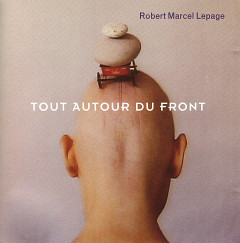
  • Tout autour du front dans Le Devoir

    «Mérite reconnu», Le Devoir, 16 février 2001
    vendredi 16 février 2001 Presse

    Les lauréats Chantal Dupont et Philippe Baulaucq étaient récompensés à la soirée d’ouverture des 19es Rendez-vous du cinéma québécois, au cinéma Impérial, à Montréal, hier soir. Mme Dupont, réalisatrice du vidéo Du front tout le tour de la tête, devient la première lauréate du prix du Conseil des arts et des lettres du Québec, assorti d’une bourse de 5000$. La récompense est remise à «la meilleure œuvre d’art ou d’expérimentation’» d’un créateur des arts médiatiques. Philippe Baulaucq reçoit le prix Lumières-B. Mac, de l’Association des réalisateurs et réalisatrices du Québec, «pour son travail éclairé à la présidence du conseil d’administration»! entre 1996 et 2000.

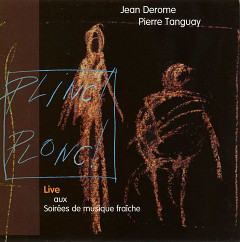
    Plinc! Plonc! dans AllMusic

    «Review», François Couture, AllMusic, 1 février 2001
    jeudi 1 février 2001 Presse

    Saxophonist Jean Derome and percussionist Pierre Tanguay have been collaborating since the early 1980s in various projects, including Les Patenteux du Québec (where all musicians play on invented instruments), Jean Derome et les Dangereux Zhoms and the Thelonious Monk tribute trio Évidence. Plinc! Plonc! is their first recording as a duo and finally offers audible proof of their special affinities. It is taken from a concert given in Quebec City on January 18, 1997. The set opens with a 17 minute free improvisation that takes Derome from flute to saxophone and his usual bird calls and small instruments. Tanguay works behind his drum set at first, but eventually moves to small percussion. Both musicians share an intuitive link and the fun they have crosses to the audience (we can hear them laugh when Derome takes out his bird calls). Another free improv, Gueding! Guedong!, closes the set, this one entirely performed on jew’s harps. Between the two are one composition by Tanguay and two by Derome, including Zuripari, a favorite of the Dangereux Zhoms repertoire here given a punchy stripped-down treatment. The set is completed by Thelonious Monk’s Ba-Lue Bolivar Ba-Lues-Are. Throughout Plinc! Plonc! the music is light, funny and effortlessly played, while remaining very much involved and challenging. This album reminds us that avant-garde music needs not always be self-centered and serious. This night in Quebec City must have been magical. Strongly recommended.

    … the music is light, funny and effortlessly played, while remaining very much involved and challenging.

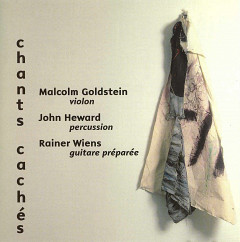
    Chants cachés dans AllMusic

    «Review», François Couture, AllMusic, 1 février 2001
    jeudi 1 février 2001 Presse

    Violinist Malcolm Goldstein, drummer John Heward, and guitarist Rainer Wiens had been playing together for five years or so when they recorded this first album in the studios of Radio-Canada, Canada’s French-speaking public radio. The trio features all the qualities expected from an experienced free improv outfit: synergy, listening capacity, compatibility in the choice of techniques. Goldstein’s signature is the most prominent one on Chants cachés (Hidden Songs). That is not to say that he leads the trio, but he has a way of setting the mood. His very personal vocabulary finds remarkable echoes in Wiens’ prepared acoustic guitar. Heward adapts his playing to the other two, using mostly his cymbals, his scrapings joining in with violin and guitar. The music is delicate, textural, inhabited by a restrained energy that only makes it more intense. Just listen to Heward keeping Trio 3 alive while the other musicians take a few steps back in order to leap farther. Chants cachés is an unlikely release for the Montréal label Ambiances Magnétiques — it was their first CD of acoustic free improvisations. Considering how Wiens’ work is so under-documented, one can’t help but be grateful.

    The trio features all the qualities expected from an experienced free improv outfit…

    Les 4 ronds sont allumés dans AllMusic

    «Review», François Couture, AllMusic, 1 février 2001
    jeudi 1 février 2001 Presse

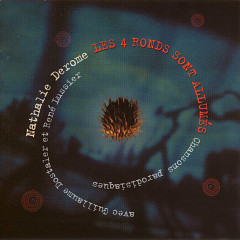
    The sister of Montréal saxophonist Jean Derome, Nathalie Derome has been working as a performing artist for many years before this album, her first, came out. Les 4 ronds sont allumés: Chansons parodisiaques (“All four burners are on: Parodise Songs”) documents a live show she performed throughout the second half of 1999. Derome is a storyteller, speaking and singing texts that are funny, subtle and poetic but also often very “Québécois,” both because of the language and the references used. Lyrics are included in the booklet, but will be of little use to anyone not accustomed to Québec slang. Her voice is not really beautiful (it recalls Joane Hétu’s, although less exploratory), but it’s captivating enough. Musical accompaniment is provides by two Ambiances Magnétiques regulars, keyboardist Guillaume Dostaler and guitarist René Lussier. The interplay between performer and musicians is interesting and one wonders at times who leads who, but for the non-francophone, Derome’s voice can be perceived as disruptive when listening to the background music. It must have been more engaging live.

    Derome is a storyteller, speaking and singing texts that are funny, subtle and poetic…

    Joue Free dans AllMusic

    «Review», François Couture, AllMusic, 1 février 2001
    jeudi 1 février 2001 Presse

    Joue Free (Play Free) is a return to basics for clarinetist Robert Marcel Lepage, as he pays a very personal tribute to Jimmy Giuffre. His acolytes are experimental guitarist Bernard Falaise (of Papa Boa and Klaxon Gueule) and jazz bassist Normand Guilbeault (the Riel project). This CD presents delicate music on the border of chamber jazz and free jazz. Lepage’s clarinet soars, drawing melodies light as a feather, while Falaise weaves textures with his pedal-volume electric guitar and Guilbeault anchors it all with his jazzier approach. As free as it may be, these pieces are partly written down and constantly kept under control. The music always remains rather calm, there are no sudden outbursts of energy — but there is no need for them. The listener is quickly drawn into the mood. On Arlequinade guitar and clarinet are fused in an impromptu melody: a magical moment. Two pieces were created for films, but they are indistinguishable from the other tracks. Some might find Joue Free a bit linear or too toned-down, but this is a good occasion to hear Falaise, still under-recorded in this kind of context.

    The listener is quickly drawn into the mood.
  • 14
  • 15
  • 16
  • 17
  • 18
  • 19
  • 20
  • 21
  • 22