Sommes dans Revue & Corrigée
vendredi 30 septembre 2022
Presse
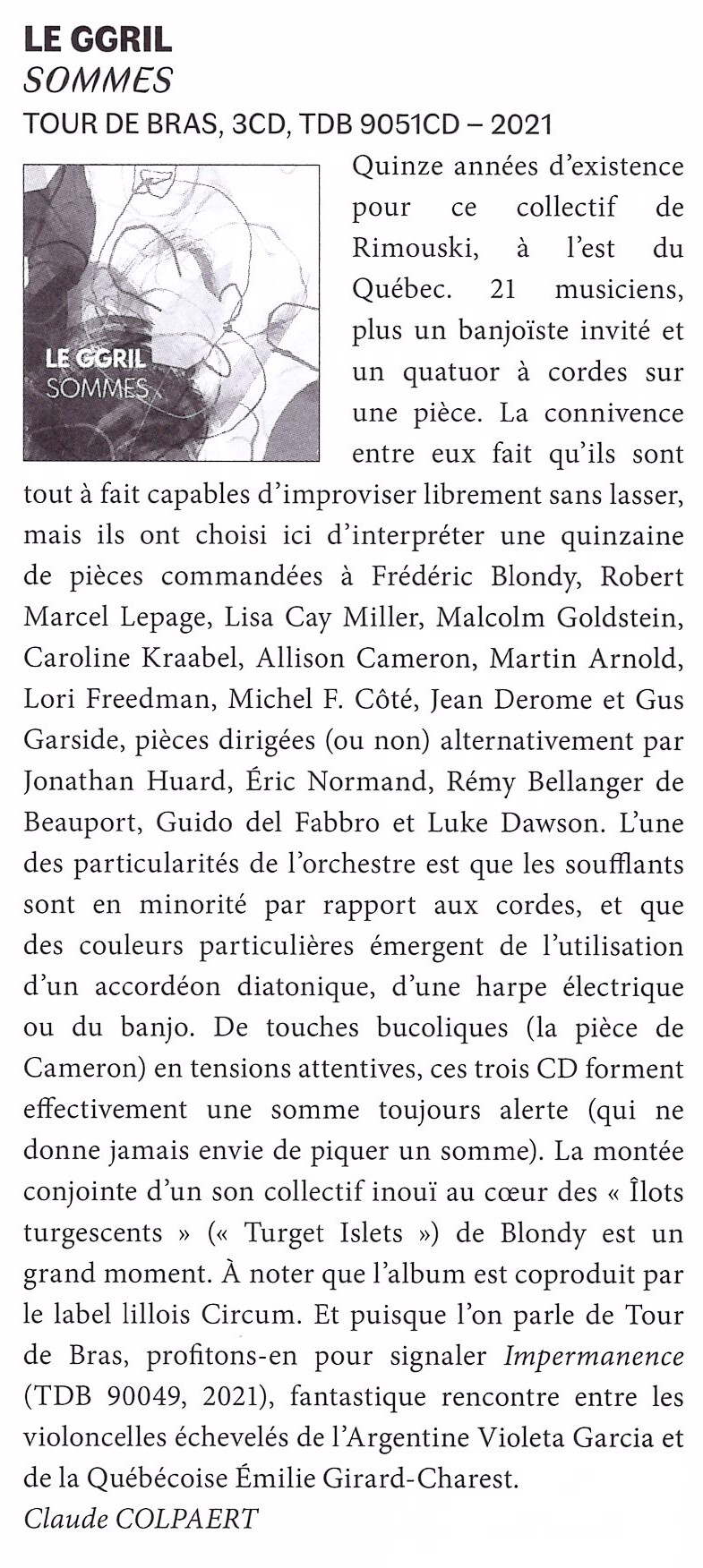

Montréal’s Ratchet Orchestra, Vancouver’s New Orchestra Workshop, and Toronto’s Association of Improvising Musicians are evidence that Canada’s largest cities have robust improvisation scenes whose participants occasionally coalesce to play works composed for larger ensembles. It is perhaps even more impressive when smaller communities pull off similar feats. Rimouski, a town with a population of 50,000, located 315 kilometres northeast of Quebec City, has Le Grand Groupe Régional d’Improvisation Libérée (GGRIL), led by bassist Éric Normand. Covering music created from 2013 to 2021, this sprawling three-CD set is a retrospective of Le GGRIL’s collaborations with twelve renowned composer-improvisers from Canada, the U.K., and France. Compared to the aforementioned ensembles, Le GGRIL tends to place less emphasis on individual virtuosity and detailed notated scores, and more on group direction and interaction. The works here display the orchestra’s flexibility in adapting to a variety of improvisational approaches.
Each CD is centred on a different theme, the first being “long and intense pieces.” Frédéric Blondy contributes the minimalistic drone of Îlots Turgescents, consisting of slowly shifting textures that build to a dense climax near the twenty-minute mark, followed by a few minutes of sparser rattles and clatters. Robert Marcel Lepage’s Alice has the orchestra trading rapid-fire short bursts of sound reminiscent of the musique actuelle genre that the composer helped originate in the 1980s. Lisa Cay Miller’s To Love That Well–Ruined Choirs is more orchestral, with small fragments of melody weaving around bubbling bass rumbles. The second CD is meditative, typified by the brief sound gestures that combine to realize Malcolm Goldstein’s Rivers and Mountains Remain, the atmosphere evoking the peaceful nature surrounding the group’s hometown. Allison Cameron’s In Memorium (Robert Ashley) is appropriately contemplative and respectful, while Martin Arnold’s Éistphéist spotlights the extended string techniques of the Bozzini Quartet. The third CD focuses on the power that a group of twenty-one improvisers can conjure, although there are moments of tranquility interspersed between the orchestral summits. Sprinkled amongst the longer improvisations on each CD is a series of short solos excerpted from Alice. Comparing these with the full version and contrasting the two takes of Caroline Kraabel’s Une note n’écoutant qu’elle même, demonstrates how different two improvisations of the same work can be.
The above outlines do not convey the improvisational details contained within each of the seventeen tracks, where much of the interest lies. Perhaps this collection will inspire other towns to form their own collectives, especially since this music must have been at least as satisfying to perform as it is to listen to.
Every now and then it’s OK to reiterate a well-worn refrain, at the risk of sounding boorish. Low-quality music can make you sick, especially when improvisation is in the picture. Hiding behind an often unjustifiable freedom of artistic expression, a lot of people, unable to behave inside the sound beyond mere technical skills, can’t stop releasing useless stuff that weighs down a reviewer’s mailbox. Things get worse when the flag-bearers of fraudulent creativity gather in collectives. Disorganized chaos and compositional shallowness melt into arrogance, causing the auditory system to go on strike. Not to mention the irritation for having wasted our dwindling time.
But Quebec’s Le GGRIL (
The substance of this triple CD — don’t be frightened, it’s the blink of an eye — comprises outstanding renditions of scores crafted for
But those are fleeting mnemonic crumbles, in the midst of mutable scenarios from which a substantial acoustic homogeneity materializes. Magnificent resonant combinations
Nous avons ajouté 6 articles à notre boutique aujourd’hui
Nous vous invitons à les découvrir