Sauter au contenu principal
actuellecd

Aussi dans le blogue

5 résultats

Excess dans Vital

«Review», Dolf Mulder, Vital, no 1181, 29 avril 2019
mercredi 1 mai 2019 Presse

Lori Freedman is a very profiled Montréal-based clarinettist, improviser and performer of contemporary composed material, by others as well by her own hand. She worked over the years with diverse composers and performers like Maurice Kagel, Joëlle Léandre, Ab Baars, etc. Excess is her latest recording and documents her solo program The Virtuosity of Excess and has Freedman performing six compositions by Richard Barrett, Brian Ferneyhough, Paul Steenhuisen, Paolo Perezzani, Raphaël Cendo and one by herself. In 2016 she toured eleven cities in North America, and I guess the recording took place afterwards. Besides bass clarinet and contrabass clarinet, freedman plays kick drum, electronics and voice. Thematically this turns is about excess: ‘With this project, I wanted to discover the beauty of the extremes, exploit them and embody them in the music’, Freedman explains. With these, she is pushing the limits of what is possible on the low clarinets. In all its virtuosity there is also pure rawness in her performance that is loaden with her emotional energy. By far the oldest composition is Time and Motion Study I composed in 1977 by New Complexity composer Brian Ferneyhough. Maybe most close the theme of excess is the opening work Interference composed by Richard Barrett in 2000. This work starts with very expressive vocals by Freedman screaming, growling and shrieking, that after a while a changed for equally growling, etc. playing of the contrabass clarinet, supplemented with some kick drum. Also, the closing work Décombres by Raphaël Cendo is a very dramatic and extravagant work for contrabass clarinet and disturbing electronic noise. Her own composition Withwhatbecomes (2016) is in contrast with the above-mentioned works in the sense that we stay more in calm and quiet regions of the contrabass clarinet, with parts that are almost of a lyrical nature.

In all its virtuosity there is also pure rawness in her performance that is loaden with her emotional energy.

Excess dans Avant Music News

«AMN Review», Daniel Barbiero, Avant Music News, 1 avril 2019
mardi 2 avril 2019 Presse

Lori Freedman’s Excess furnishes exactly what its title promises: a program of music for bass and contrabass clarinets that pushes instrumentalism to its outer edges. Freedman, originally from Toronto but now based in Montréal, is known as an improviser as well as a composer and performer of new work; it is in this latter capacity that she appears on Excess, some of whose works were written for her. Each embodies the notion of excess in its own way, whether in the quick shifts over extremes of register and dynamics of Brian Ferneyhough’s Time and Motion Study I (1977), or in the expressive excess of Richard Barrett’s Interference (2000) for contrabass clarinet, voice and kick drum. In opening the recording with the confrontational sounds of Interference, Freedman seems to throw down a challenge to the listener to stay with the recording and hear her out. Persistence will be rewarded. Paul Steenhuisen’s 2015 composition Library of Fire, for bass clarinet, was composed for Freedman and alludes directly to her skills as an improviser: the piece was created out of transcriptions of some of her recorded improvised performances. The growls, shrieks and half-articulated, half-breathy sounds of Paolo Perezzani’s Thymos (2014), for contrabass clarinet capture the emotional immediacy and drive of the ancient Greek concept of the thumos, that human faculty thought to be responsible for prodding a person to take up a challenge and grapple with it in a spirited way. As to Freedman’s challenge to the listener, this virtuoso set shows it to be something worth meeting.

… this virtuoso set shows it to be something worth meeting.

Excess dans The WholeNote

«Review», Stuart Broomer, The WholeNote, 27 mars 2019
mardi 2 avril 2019 Presse

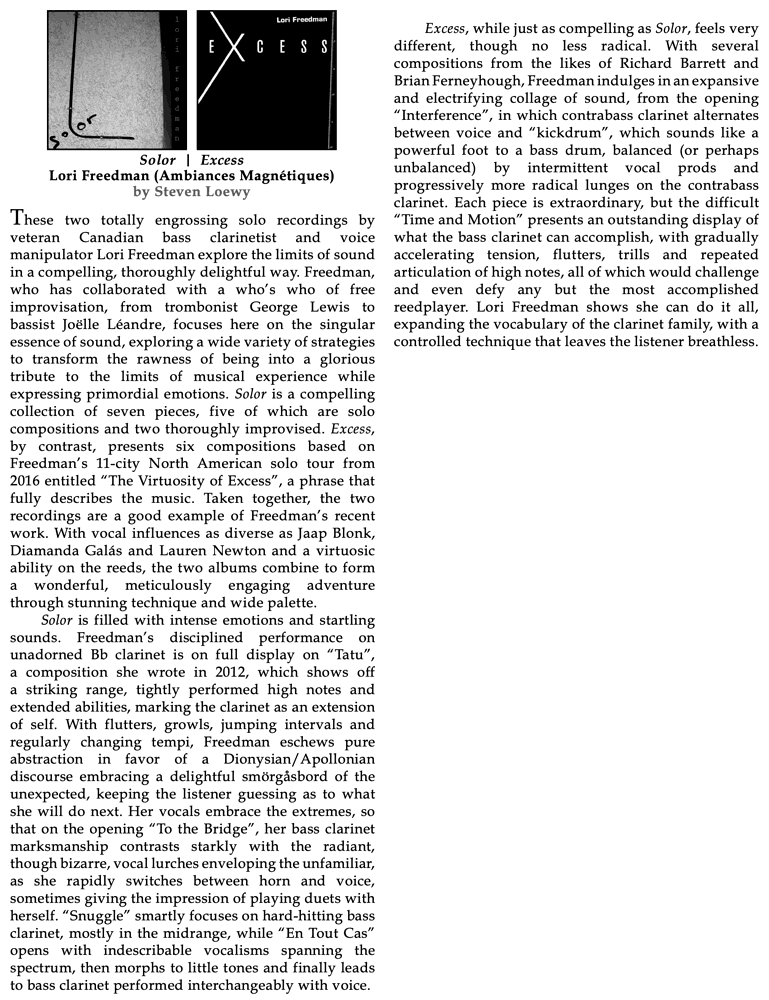
On Excess, distinguished Montréal-based clarinetist Lori Freedman presses the boundaries of contemporary musical discourse, challenging the clarinet’s, the individual composer’s and her own expressive depths. Pressing a point, she focuses on bass and contrabass clarinet, perhaps the most vocal of orchestral instruments, with every pitch ready to bend and break, a spray of overtones seemingly ever at the ready. Oh, yes, she challenges the listener as well.

The program is bracketed by its most radical and expansive adventures. British composer Richard Barrett’s Interference requires the performer to sing over a four-octave range and play a kick-drum as well as turn in a virtuosic explosion of wild burbling lines from the contrabass clarinet. It’s shamanic work, an invocation of spirits, a depth of expression that tests the limits of performance. At the opposite end of the CD, there’s French composer Raphaël Cendo’s Décombres, a work of “saturation” that fills the sound space with roaring contrabass clarinet and abrasive electronics.

In between, Freedman reaches back to Brian Ferneyhough’s daunting Time and Motion Study I (1977) and explores three recent pieces. Freedman worked closely with Vancouverite Paul Steenhuisen on Library on Fire and Paolo Perezzani on Thymos, the former mixing vocal sounds with bass clarinet, the latter the sonic potential of the contrabass, elephants and all. It’s her own Withwhatbecomes that’s most remarkable: almost unvoiced, it’s filled with the quietest, most fleeting, evanescent sounds, more challenging in its own way than anything else here.
On Excess, distinguished Montréal-based clarinetist Lori Freedman presses the boundaries of contemporary musical discourse, challenging the clarinet’s, the individual composer’s and her own expressive depths.