Sauter au contenu principal
actuellecd

Aussi dans le blogue

10 résultats
  • 1
  • 2
  • Bruit court-circuit dans The Squid’s Ear

    «Heard in», Dave Madden, The Squid’s Ear, 19 juin 2013
    mercredi 19 juin 2013 Presse

    When is one allowed a free pass to use “super” in the title of his / her band name? If you boil down the CV of those participating in Bruit court-circuit, you get a PhD in art, one in composition, collaborators with Jandek, Chris Cutler, Fred Frith, Joëlle Léandre, Zeena Parkins; a co-founder of Ambiances Magnetiques, a former touring member of Gilles Ste-Croix’s horse circus Cheval-Théâtre, an educator of improvised music (presented to 4th and 5th grade classes) and the lynchpin triangle of Michel F Côté, Alexandre St-Onge and Martin Tétreault, a trio connected five degrees or less with everything exciting in Montréal during the past decades. Violin (Guido Del Fabbro), cello (Émilie Girard-Charest), turntables (Tétreault), microphone manipulation (Côté), saxophones and objects (Jean Derome, Joane Hétu), lots of percussion (Danielle Palardy Roger, Côté), synth (Vergil Sharkya’), electric bass (St-Onge) — SuperMusique works for me.

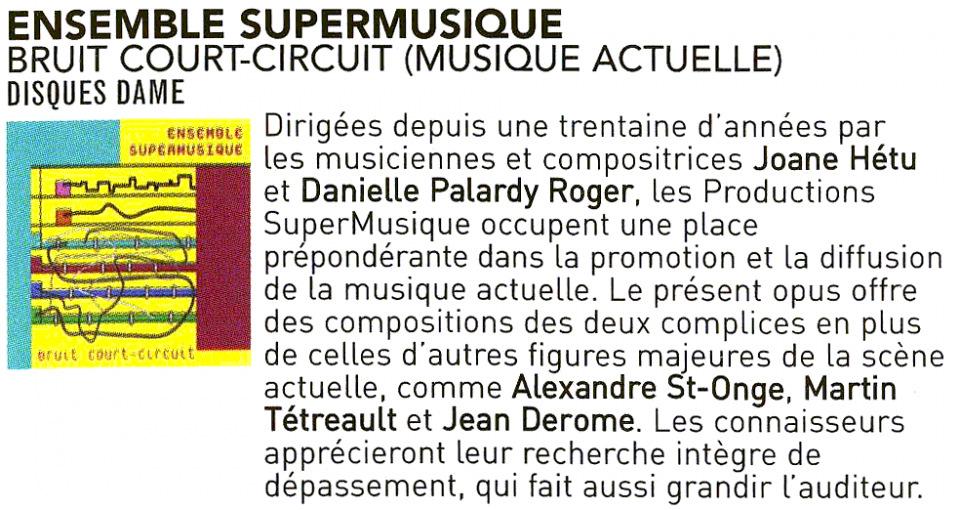
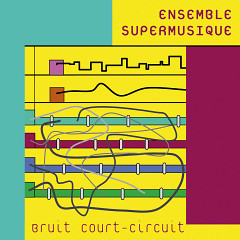
    Bruit court-circuit is not so much a story but a theatrical event where abrupt scene (ry) and costume changes and blurring performer lines keep the audience in continual transport (the clues of pending shifts are roughly scrawled graphic scores on the cover art). For example, the opener “Malgré tout face A” begins with an uninspired rock drum groove, but we’re only four bars in before the discord of a two-minute rivulet of declarative, dotted bursts from all participants skews the direction; each player’s multi-variations here, from hardbop runs to R&B licks to fizzing wah-wah to pointillism to hints of Serialism to Bartok quotes to someone’s metal growl of “électrocution!”, declare “prepare to be astounded”. Without notice, the work breaks with an intermission of tapping / blips / sforzando and moves to a soothing female spoken-word performance with the ensemble punctuating and creating subtle intrigue alongside the recitation. Just as the drama is about to peak, the woman’s voice skips, continues on with just the repetition of “le spécimen moderne” and the sound a turntable makes when you bump into it, and you note the illusion and play on recorded medium (presumably) Tétreault just pulled. Clever boy.

    Acouphènes en partage (translated as “sharing in tinnitus”) breathes like passive Gagaku with a group effort of high-pitched, sustained notes and “natural” (as in the random “placement” sounds you hear walking down the street) thumps and ticks, the players eventually embellishing with vibrato and breaking the steady tandem texture as an overwhelming deep tone sneaks in underneath. And then a switch to rumbling motors and a sine wave to mess with your tinnitus, and then passages of warbling reeds, a culminating blend of these elements, a disruption of Del Fabbro and Girard-Charest pinching and grinding strings.

    On paper, Bruit court-circuit appears confusing and odd — in a bad way; summaries of individual tiles that are “occasional down-on-the-prairie fiddle duo sweetness ties an abandoned, irradiated city together” (Poème à faible résistance) and “a repeating squeal works into an arcade game Boss Battle theme” (Le fruit du hasard) are curious and accurate, but don’t do justice to the aural representation and pattern of the mosaic. Unfortunately for those who aren’t following along with the music in their ears, this unique, vibrant, genre-splattering mix begs a listen to appreciate the meld of Ensemble SuperMusique’s technical and creative prowess and virtuosic structural / improvisation narrative. So get on that.

    unique, vibrant, genre-splattering mix

    Bruit court-circuit dans Vital

    «Review», Dolf Mulder, Vital, no 881, 6 mai 2013
    lundi 6 mai 2013 Presse

    Ensemble Supermusique interprets six compositions, by the hands of Tétreault, St-Onge, Roger, Hétu and Derome. They are also the players of these pieces together with Émile Girared-Charest (violoncello),Vergil Sharkya (synthesizer), Michel F Coté (drums, microphones) and Guido del Fabbro (violin). The opening piece Malgré tout Face A is an work by Tétreault. Based on a straight and simple beat, sampled sounds, voice,s, etc. are put over it. Halfway after a break of silence, a narrator speaks with mellotron-like sounds in the background. Also in his second piece on this album, Malgré tout Face B experiments with beat. In Le fruit du hasard by Derome, rhythm and melody and not far way. In all other compositions we are dealing with far more abstract soundconstructions, built from a diversity of sounds, instruments and objects. An example of this is the piece SM: re-trait de l’abjection, the work I liked most. The ensemble uses noise-esthetics, sound-improvisation, sprechgesang, acoustic and electronic soundsources, etc, for well-defined excursions and compositions, that are far more than just an eclectic mix. But a new musical language.

    The ensemble uses noise-esthetics, sound-improvisation, sprechgesang, acoustic and electronic soundsources, etc, for well-defined excursions and compositions, that are far more than just an eclectic mix. But a new musical language.

    Bruit court-circuit, La femme territoire ou 21 fragments d’humus, Wow!, Ambiances Magnétiques, DAME dans La Scena Musicale

    «Ambiances nouvelles», Marc Chénard, La Scena Musicale, 1 février 2013
    vendredi 1 février 2013 Presse

    À l’automne 2011, le mot courait depuis un moment dans le milieu des musiques actuelles de Montréal que l’étiquette maîtresse du genre, Ambiances magnétiques, cesserait ses activités. Fondée en 1983 par un noyau de musiciens novateurs, la maison allait établir un style aux confins de tous les autres: loin du jazz, mais zyeutant la musique improvisée libre, se tenant loin de la pop la plus rock, mais attirée tout de même par ses tendances plus expérimentales, cette jeune cohorte ne dédaignait pas non plus les recherches de pointe en musique contemporaine, sans toutefois se camper dans des partitions entièrement écrites.

    De ses débuts modestes, l’étiquette prit son plein essor en 1992 avec l’établissement de sa maison de distribution Dame Distribution musique actuelle. D’une vingtaine de titres à cette époque, le catalogue passa à plus de 200 titres, comptant plusieurs parutions incluant des grandes pointures internationales en musiques de création.

    Mais tout juste un an après la sortie de sa «dernière» cuvée, Ambiances nous revient, tel un Phénix renaissant de ses cendres. En effet, trois nouveaux titres s’ajoutent à son catalogue, ceux-ci lancés en public à la mi-décembre. Profitant de l’occasion, on signalait la reprise de ses activités mais à un rythme réduit, trois ou quatre nouveautés par an au plus. Sans plus tarder, passons à ces trois albums en question.

    Quatrième document issu du trio Derome-Guilbeault-Tanguay, Wow! (AM209) confirme la merveilleuse confrérie de ces trois complices empreints de jazz jusqu’aux bouts de leurs phalanges. Se vouant bien sûr au répertoire de la note bleue, le groupe propose également des compositions tout aussi convaincantes de Derome, qui excelle toujours à la flûte, tout comme à ses deux saxos. Guilbeault, de sa pulsation de roc, est un véritable Gibraltar, Tanguay est un modèle de swing et d’inventivité. Que vous ayez entendu les autres enregistrements, peu importe, tout fana de jazz ne saurait se passer de ce disque au titre des plus pertinents.

    Autre disque, autre proposition musicale, celle-ci nous vient de l’Ensemble SuperMusique (Bruit court-circuit AM210). Cette formation «toutes étoiles» (à défaut d’un meilleur descriptif) incarne comme nulle autre l’esthétique de ce collectif. Six titres s’étalent sur cette surface d’un peu plus de 50 minutes, l’un d’eux offert en deux versions d’ailleurs si dissemblables qu’il est difficile de reconnaître leur parenté. Outre Derome (qui, chose intéressante, joue du saxo ténor ici), on retrouve les Martin Tétreault, Joane Hétu, Danielle Palardy Roger et des plus jeunes comme Guido del Fabbro (vln), Émilie Girard-Charest (vcl.) et Virgil Sharkya (synthé.) Les habitués seront comblés.

    La Femme territoire (AM211), enfin, est une œuvre de plus d’une heure de Joane Hétu, créée à l’Agora de la Danse en 2010. J’ai assisté au spectacle et apprécié, mais il manque ici la dimension visuelle de cet événement pluridisciplinaire (dont on peut voir quelques photos dans le livret incluant tous les textes lus et chantés). Je laisse donc aux auditeurs le soin de former leur propre opinion sur ce disque.

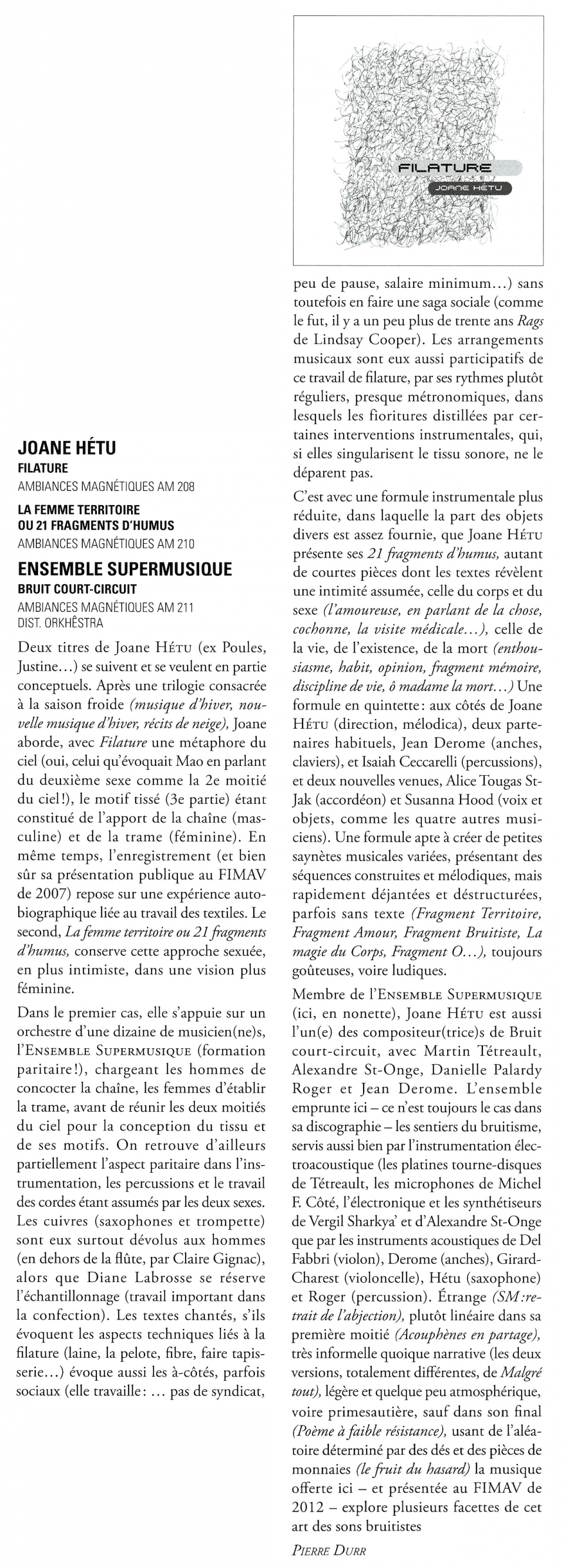
    Mais tout juste un an après la sortie de sa «dernière» cuvée, Ambiances nous revient, tel un Phénix renaissant de ses cendres.
  • 1
  • 2