Sauter au contenu principal
actuellecd

Aussi dans le blogue

23 résultats
  • 1
  • 2
  • 3
  • 4
  • Mingus Erectus, Pee Wee et moi, The Feeling of Jazz dans Point of Departure

    «Review», Bill Shoemaker, Point of Departure, no 5, 1 mai 2006
    lundi 1 mai 2006 Presse

    Among the First World’s experimental music communities, Québec’s Musique actuelle community is one of the more insular. One might surmise that they are sufficiently supported at home, making travel less the priority it is elsewhere in North America. Certainly, developing a US audience is nowhere near the top of their list, even though most of the New England is within reasonable driving distance from Montréal. Their CDs are not covered by such basic reference books as The Penguin Guide To Jazz On CD. They are busy living and doing their work, the overwhelming bulk of which bears only a passing resemblance to that from other communities. That’s why it is intriguing that these musicians would unabashedly celebrate mid-century American jazz in three concurrently released CDs.

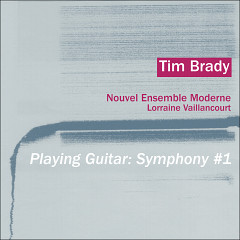
    For many interpreters of Charles Mingus’ compositions, the depiction of volatility seems to be the bar they strive to clear. And, bassist Normand Guilbeault’s well-balanced quintet on Mingus Erectus does that time and again with disarming ease. Part of this is attributeable to his choice of compositions like Pithecanthropus Erectus, which has Mingus’ signature mix of brooding and lashing-out, and All The Things You Could Be?, which gives ample space for soloists to work off Mingus’ emotional spikes. Guilbeault’s front line of clarinetist Mathieu Bélanger, trumpeter Ivanhoe Jolicœur, and Jean Derome, who plays flute and alto and baritone saxophones, meets these demands very well (the band is rounded out by drummer Claude Lavergne, who ably plays the role of Dannie Richmond). What they do better than most, however, is convey the gush of Peggy’s Blue Spotlight and the whimsy of Tijuana Gift Shop, not as the highs of a mood swing, but as fully realized moments. Guilbeault also milks the sarcasm of Fables Of Faubus with anti-Bush lyrics like “you’re so sick and ridiculous” that actually fit the idiosyncratic melody. These facets of Mingus’ music coalesce into a vivid portrait. It may not seem so at first, but Pee Wee Russell is almost as tough to interpret as Mingus, but for a host of different reasons. The arch eccentric of the generation that came of age in the late ‘20s and early ‘30s, the clarinetist committed several endearing heresies late in life, such as playing with Thelonious Monk at Newport, and recording both Monk and Ornette Coleman tunes for Impulse. His playing was rife with odd phrases saturated by a disaffected, wobbly tone, which makes him vulnerable to bad caricature if the swing is sapped from his phrasing to emphasize his idiosyncrasies, or if his quirky intonation is overdone. Robert Marcel Lepage gets it right on Pee Wee et moi by sticking with the blues and not delving into Russell’s drink and depression riddled personal life. At his best, Russell’s playing conveyed wizened joy as it unhinges from the quotidian, which Lepage emphasizes throughout this album-length suite. He brings on a half-dozen clarinetists — Guillaume Bourque, François Houle, Jean-Sébastien Leblanc, André Moisan, Pierre-Emmanuel Poizat and Richard Simas — who hoot and wail with an appealing vigor (unfortunately, there’s no score card to tell them apart). While Guilbeault and drummer Pierre Tanguay simply steam throughout the date, the real wild card is guitarist René Lussier, whose off-kilter blues phrases and occasionally maniacal strumming frequently jolt the proceedings. Pee Wee et moi is a great wild ride. Trio Derome Guilbeault Tanguay is something of a Québécois Clusone Trio. Both groups love jazz enough to be occasionally irreverent with the genre. The comedic roles within the two trios differ: Derome is not as deadpan as Michael Moore; Tanguay’s humor is gentler than Han Bennink’s; and Guilbeault can’t match Ernst Reijseger’s ability to lay the cello across his lap like a guitar. And, their respective tastes bypass bebop, favoring the likes of Ellington, Kern and Porter. When they tap a post-war source on The Feeling Of Jazz, Trio Derome Guilbeault Tanguay tend towards the books of cool characters like Lee Konitz and Misha Mengelberg, though they also give Sonny Clark’s Sonny Crib a sufficiently gritty reading. Trio Derome Guilbeault Tanguay arguably has a tad more punch in their delivery, due to Derome’s harder-edged alto and baritone, the lower reach of Guilbeault’s bass, and Tanguay’s simmering grooves. This is an excellent album, which may pull Trio Derome Guilbeault Tanguay into the international limelight.

    Mingus Erectus, Pee Wee et moi, The Feeling of Jazz, Ambiances Magnétiques Jazz dans Coda Magazine

    «Label Spotlight: Ambiances Magnétiques Jazz, Jazz becomes Actuelle», Ken Waxman, Coda Magazine, no 326, 1 mars 2006
    mercredi 1 mars 2006 Presse

    Need further proof that Quebec is a province pas comme des autres? At a time when jazz record labels and musicians lament lack of acceptance and opportunities, Ambiances Magnétiques, the longestablished, Montréal-based musique actuelle label has just set up a specific jazz imprint.

    The reason is partially artistic and partially marketing, explains Joane Hétu, founder member of the AM collective, and artistic director of DAME, its distribution and marketing wing.

    Musique actuelle as defined by our community implies that the composer is also performer of his music,” she says, elaborating the philosophy that has guided AM since its inception in 1983. Yet with many of AM’s founders recently involved with projects honoring the compositions of jazz icons, such as bassist Normand Guilbeault’s new CD, Mingus Erectus, the need for a specific jazz label became apparent.

    “Montréal’s jazz community is active all year long,” she notes. “With l’Off Festival de jazz de Montréal, a new Regroupement des artistes de jazz et de musique actuelle du Québec and a new interest in jazz from many musicians, now seemed as good a time as ever to support these artists.”

    However, after having released more than 150 CDs, AM has established a certain reputation and market, the couple of jazz sessions previously released by the label “often ended up in the wrong sections in stores or in the hands of reviewers more interested in musique actuelle,” she adds. “Ambiances Magnétiques Jazz (AMJ) allows our jazz releases to be clearly identified, categorized, reviewed and marketed in the jazz family.”

    Although AMJ’s first CDs — clarinetist Robert Marcel Lepage’s Pee Wee et Moi and reeds-bass-drums Trio Derome Guilbeault Tanguay’s The Feeling of Jazz are the others — came out at the same time as Mingus Erectus in late 2005, this clustering was “just luck,” she concedes. Each artist, an AM founding member, happened to have a project ready, although Hétu adds “having many releases over a short time period should help put our jazz label on the map.”

    It’s too early to gauge AMJ sales, but like most of the label’s product, there’s a close correlation between live performance and a CD’s popularity. “It’s all about playing live,” she declares. “The more concerts the more sales.”

    Among the 10 or so CDs AM releases each year, she expects that two to four will be jazz. But since AM is designed to give artists mastery over their work, it depends on what projects are offered to the label. Already scheduled for spring release is a trio disc by Quebec guitarist Antoine Berthiaume with bassist Michel Donato and drummer Pierre Tanguay and another by Italian pianist Gianni Lenoci’s Ensemble. Lenoci’s CD will be AMJ’s first disc by a nonCanadian. However since the parent label’s releases aren’t limited by geography, Hétu suspects AMJ will follow the same policy.

    Again though, Hétu cautions that AM’s overriding raison d’être is to release, distribute and market CDs by its founding members or those recommended by a member committee. Busy with its own projects, AMJ won’t go out of its way to seek out new jazz talent. “We’ll leave the creation of a Canadian Jazz Idol to someone else,” she jokes.

    … Montréal-based musique actuelle label has just set up a specific jazz imprint.

    Mingus Erectus dans Jazz Word

    «Review», Ken Waxman, Jazz Word, 6 février 2006
    lundi 6 février 2006 Presse

    Taking on the œuvre of Charles Mingus is a major challenge for any band, especially one led by a bass player. Not only, as in all jazz repertoire efforts, does the group have to avoid slavish imitation, but Mingus’ work also has to be presented with the sort of cocksure aggression that characterized the man himself.

    Many musicians have tried to defy these odds, though few have been very successful. There are the various versions of the Mingus Big Band – Sue Mingus, Prop. – that with a bit too much fealty to the bassist’s widow, manage to perpetuate the bassist’s memory with unexpected versions of some of his better and lesser-known work.

    Then there’s this left field entry. Organized by Montréal bassist Normand Guilbeault, it features a cross-section of that city’s musique actuelle players in a rare foray into unhyphenated jazz. Perhaps that’s why there’s freshness to these tunes – some of Mingus’ Greatest Hits – that have been played by many over the past four or five decades, and very frequently in the 26 years since the bass man’s death.

    Musique actuelle is defined by its practitioners as music of today. Performed, it can have as many references to ProgRock, electronica, movie themes, contemporary, so-called serious music and traditional chansons as jazz and improv. Jean Derome, who plays alto and baritone saxophones and flute here, is involved in many of those mutant forms, yet turns in a surprisingly nuanced and jazzy take on Mingus. At times you could swear the solos are coming from altoist Jackie McLean or baritonist Pepper Adams, some of the legendary bassist’s favored sidemen. MDMD, the one non-Mingus composition here, is Derome’s as well, and cleverly slips in among Chazz’s work without a ripple. Drummer Claude Lavergne and trumpeter and flugelhornist Ivanhoe Jolicoeur have also been mainstays of musique actuelle over the years as has clarinetist Mathieu Bélanger, who brings outstanding atypical textures to this CD, with his standard and alto clarinet excursions on passages usually confined to saxophone reeds.

    Of course the compositions’ overriding visualization comes from leader Guilbeault, who has involved himself in this repertoire for about 15 years, and recorded an earlier Mingus tribute a decade ago. Montréal-born, he’s one of the few musique actuelleers with a straight jazz background having played with such local heroes as guitarist Nelson Symonds and drummer Bernard Primeau. He has also worked with Québécois singers, on major projects conceived of by Derome, guitarist René Lussier and percussionist Michel F Côté, his own Parkerouac, wedding poetry and jazz and Riel, a musical about a 19th Century government-executed French-Canadian firebrand.

    From inception, the eight tracks of Mingus Erectus balance on the Guilbeault’s rhythmic smarts. But his underpinning is flexible enough to allow Bélanger, Jolicoeur and especially Derome a 21st Century latitude with the tunes. Thus pieces may include multiphonic shout choruses plus sudden shifts of tempo and pitch without every losing the foot-tapping beat. Bélanger’s horn often sounds Québécois street band slurs and glissandi as much as traditional blue notes. Mixing his note-bending with brassy plunger work, Jolicoeur alternately brings to mind Ted Curson and Roy Eldridge, two trumpeters from different generations who recorded with Mingus. This is especially apparent on Conversations, where contrapuntal lines from the horns evolve from call-and-response to individual statements, including the trumpeter’s cascading triplets. All the while Guilbeault keeps up the ostinato, sometimes double-strummed.

    On a shrill, almost piccolo-sounding flute, Derome’s cunning enlivens Tijuana Gift Shop, as harmonic convergence with the snorting trumpet lines and near-Dixieland clarinet glisses brings even more of a Latin tinge to the tune. Using a harsh vibrato and a hard reed, Peggy’s Blue Skylight becomes a baritone saxophone feature for Derome, with his stomping vibrato matching the powerful polyphonic bass work and contralto, contrapuntal coloring from the clarinetist.

    Another highpoint appears with a recasting of 1959’s Fables of Faubus as 2005’s Fable of (George Dubya) Faubus. Retaining the circus-like mockery of the original –, a barb launched at Arkansas’ then segregationist governor – the Ensemble widens the sarcasm to lambaste the American president’s excursion into Iraq. It’s a technique Mingus often followed himself, taking on Richard Nixon, Nelson Rockefeller and other politicians later in his life.

    However, it’s a bit surreal to hear “No more stupid wars” and “Boo George Bush with your evil plan” shouted out in a heavy a Québécois accent. But the instrumental work is at the same high level as the initial recording of the piece and its subsequent recording with Curson and Eric Dolphy. Bélanger’s mellow, chalumeau tone keeps the tune moving forward, as the others provide a wavering countermelody. Derome double-tongues his alto saxophone reed and Jolicoeur growls timbres from deep inside his horn. One of the few Mingus tributes that approaches the passion and commitment of the honoree, Mingus Erectus inculcates a desire to hear Guilbeault and company in other contexts.

    One of the few Mingus tributes that approaches the passion and commitment of the honoree, Mingus Erectus inculcates a desire to hear Guilbeault and company in other contexts.

    actuellecd.com aux Prix Opus

    jeudi 8 décembre 2005 Général

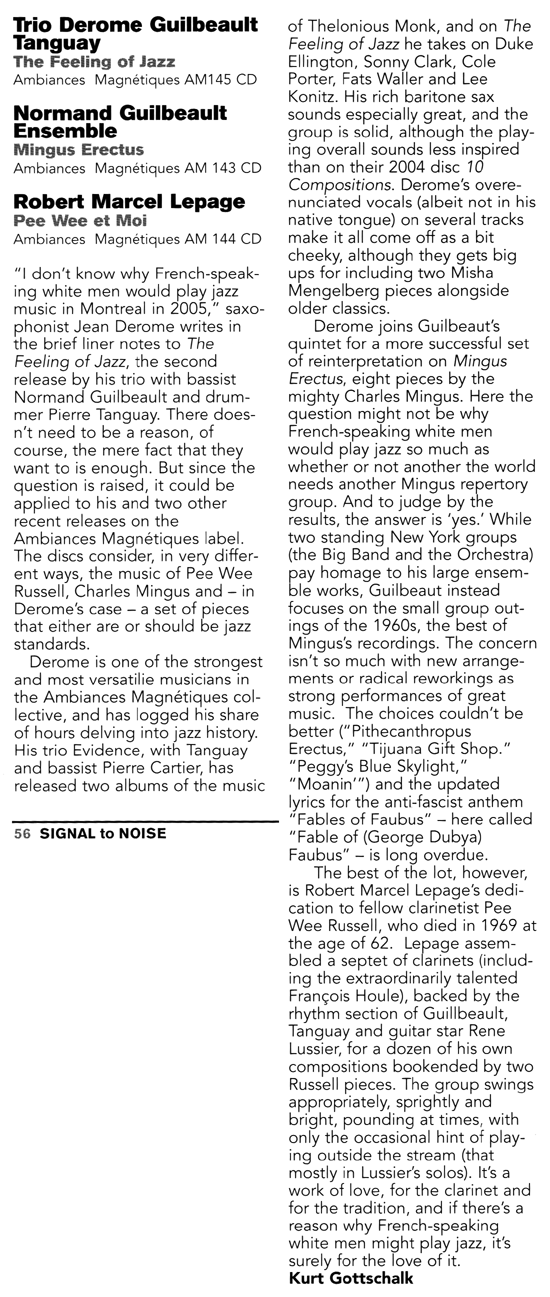
    Plusieurs artistes actuellecd.com sont en nomination au 9e Prix Opus, remis depuis 1996 par le Conseil québécois de la musique. Le concert Palimpseste d’orchestre, qui revisitait les musiques de Joane Hétu, Diane Labrosse et Danielle Palardy Roger, est en nomination dans la catégorie «Concert de l’année — Musiques actuelle, électroacoustique». Playing Guitar: Symphony #1 de Tim Brady et Portrait Montréal du Quatuor Bozzini se feront face dans la catégorie «Disque de l’année — Musiques moderne, contemporaine». Canevas «+» de l’Ensemble SuperMusique et Estrapade de morceaux_de_machines ont été retenus dans la catégorie «Disque de l’année — Musiques actuelle, électroacoustique». Finalement, Mingus Erectus, du Normand Guilbeault Ensemble a été sélectionné dans la catégorie «Disque de l’année — Jazz, musiques du monde». Les gagnants seront dévoilés le 22 janvier 2006.
  • 1
  • 2
  • 3
  • 4