Sauter au contenu principal
actuellecd

Blogue

202 résultats
  • 23
  • 24
  • 25
  • 26
  • 27
  • 28
  • 29
  • 30
  • 31
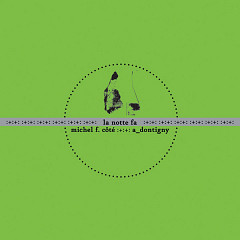
  • La notte fa dans Eartrip

    «Review», David Grundy, Eartrip, no 5, 1 mars 2010
    lundi 1 mars 2010 Presse

    Jittery, cut-up music in which a barrage of samples — fragments of barely-recognisable speech, conventional instruments running a gauntlet of electronic distortion, snippets of grooves and beats that have been pulled and stretched and chopped to pieces — collide and (less frequently) cohere into a soundscape that can strike one at different moments as either fun, in a kind of crazy, sped-up way, or nightmarish, for pretty much the same reason. The starting point here would seem to be the more experimental moments of Autechre or Aphex Twin, with the tendency to repetitive, danceable beats knocked to one side to leave something which has a definite physical pull to it, but which isn’t going to make you dance to any sort of regular rhythm– rather, your stop-start spasms will give you away as a madman dancing to the disrespectful voices in your head. There’s no real question of ‘soloing’ here, or even of distinguishing between the various musicians, given the way that everything is mashed-up through electronics: the occasional beats which can be heard to come from a conventional drum-kit are soon overlaid with all manner of computerised sputters and run-away loops, and Jean René’s viola, which might have pulled things in a more ambient direction (à la Coil’s Moon’s Milk) is kept firmly to the bottom of the mix on his one contribution to the album. It’s rather like listening to a radio station with really fucked-up reception for an hour, the few moments of respite being provided through samples of Maurice Ravel’s Ma mère l’oye and a Don Cherry trumpet piece that appear, are toyed with, mangled out of recognition, and then discarded for the next set of electronic whirligigging. Another comparison might be the sample-overload of early Public Enemy without the (relatively) stabilising element of Chuck D and Flavor Flav’s vocals, which are at least determinedly about something: no such reference points here. One is left to conclude, then, that it’s best to avoid looking for comparisons, for generic references, as they’re pretty much useless in describing music that’s so determinedly askew, so schizophrenically active, so resistant to easy digestion and to standardised comprehension as this; music as chemical substance, hurtling through the blood-stream, sparking all sorts of strange, shuddering journeys through the brain.

    One is left to conclude, then, that it’s best to avoid looking for comparisons, for generic references, as they’re pretty much useless in describing music that’s so determinedly askew, so schizophrenically active, so resistant to easy digestion and to standardised comprehension as this…

    Sainct Laurens dans The WholeNote

    «Extended Play — Pomo Duos», Ken Waxman, The WholeNote, no 15:6, 1 mars 2010
    lundi 1 mars 2010 Presse

    Duo playing is probably the most difficult kind of improvising. Not only must each player depend on only one other to modify or accompany his ideas, but unbridled creativity has to be muted to fit the other musician’s comfort zone. As these CDs demonstrate, skilled improvisers aren’t fazed by the challenge; but the instruments they choose are sometimes unusual. […]

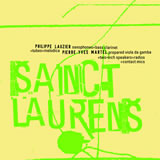
    Pierre-Yves Martel and Philippe Lauzier also mix electro and acoustic timbres – and more – on their CD Sainct Laurens (&records 06). Although Montréaler Lauzier confines himself to saxophone and bass clarinet, Martel, who lives in Montréal and Paris, suggests 17th Century music at points, since he plays the viola da gamba. He’s thoroughly modern elsewhere, preparing his instrument with speakers, contact mics and radios. The nine tracks range from lyrical showcases where Lauzier’s wide woodwind warbles brush up against sympathetic Renaissance-styled string vibrations; to abrasive and gritty scrapes, squeaks and flanges from Martel’s extended strings that contrast with intense, horizontal split-tones from the saxophonist. Defiantly multiphonic, the most characteristic track is Adda. It matches altissimo bass clarinet squeals with animal-like burrowing scratches plus droning oscillations from the plectrumist. Swelling into a cornucopia of stifled reed split tones and pinched string buzzes, the piece rends the sound space with both high and low-pitches before the distinctive parts meld.

    The nine tracks range from lyrical showcases […] to abrasive and gritty scrapes, squeaks and flanges from Martel’s extended strings that contrast with intense, horizontal split-tones from the saxophonist.

    Live • 33 • 45 • 78 dans The WholeNote

    «Extended Play — Pomo Duos», Ken Waxman, The WholeNote, no 15:6, 1 mars 2010
    lundi 1 mars 2010 Presse

    Duo playing is probably the most difficult kind of improvising. Not only must each player depend on only one other to modify or accompany his ideas, but unbridled creativity has to be muted to fit the other musician’s comfort zone. As these CDs demonstrate, skilled improvisers aren’t fazed by the challenge; but the instruments they choose are sometimes unusual. […]

    Glen Hall has organized the annual 416 Toronto Creative Improvisers Festival since 2001. Guests from the 514 area code were welcomed last year, with Montréal turntablist Martin Tétreault’s sounds most unique. Live • 33 • 45 • 78 (Ambiances Magnétiques AM 191 CD), a duo with Berlin-based turntablist Ignaz Schick, provides examples of these jangling and ratcheting textures. Unlike hip-hoppers who use LPs to insert song snatches or scratch beats, the Canadian-German duo manipulate tone-arms and cartridges as additional sound sources, while pummelling electrified surfaces for distinctive timbres. In two suites they mix granulated rubs and rattles, sharp rugged smacks and motorized rasps with beneath-hearing-level clatter and hisses to reveal textures ranging from stallion-like whinnies to forte ostinatos replicating a dentist’s drill. By the climax of Cave 12 they create a double-counterpoint showcase. The piece weaves vinyl needle rips, frenzied buzzes, static vibrating, video-game-like clanking and near-human cries into a neat package of harmonic interface, as multi-textural as it is percussive.

    In two suites they mix granulated rubs and rattles, sharp rugged smacks and motorized rasps with beneath-hearing-level clatter and hisses to reveal textures ranging from stallion-like whinnies to forte ostinatos replicating a dentist’s drill.

    Ugly Beauties dans All About Jazz

    «Review», Andrey Henkin, All About Jazz, 28 février 2010
    dimanche 28 février 2010 Presse

    A quick perusal of Canadian pianist Marilyn Lerner’s website presents a musician whose projects are both typically and atypically diverse. Usually range demonstrates itself in working with a large pool of other musicians; Lerner certainly has that, whether it is with the long-standing Queen Mab to the two trios under discussion here. But she also cuts a wide swathe stylistically. Her website discography is split amongst Improvisation, Jazz, Classical, Jewish Music and Audio Art. None of these are affectations; her playing in any context is sincere and persuasive.

    The trio Ugly Beauties is obviously a Monk tribute band, right? Well, yes and no. When this reviewer saw the band at last summer’s Vancouver International Jazz Festival, they did play a couple of his pieces. But for their eponymous debut recording, there are none, the music coming from the pen of each member or as duo or trio collaborations. And even Monk would be somewhat taken aback at the European-style openness of the playing though he would appreciate the brevity of the 15 tracks (55 minutes in total, with only one tune hefty at nine minutes). Fellow Canadians Matt Brubeck (cello) and Nick Fraser (drums) are the other two sides of the equilateral triangle and both have a breadth to their resumés that equals Lerner’s. Thus Ugly Beauties may be a jazz record but one that is quite brash in revealing the layers of other musics integral to jazz’ vitality. The spirit of Monk is far better served by a group that uses his individuality as inspiration rather than retreads his music for the 1000th time, though Ugly Beauties probably would do it better than most.

    The spirit of Monk is far better served by a group that uses his individuality as inspiration
  • 23
  • 24
  • 25
  • 26
  • 27
  • 28
  • 29
  • 30
  • 31