Sauter au contenu principal
actuellecd

Blogue

198 résultats
  • 25
  • 26
  • 27
  • 28
  • 29
  • 30
  • 31
  • 32
  • 33
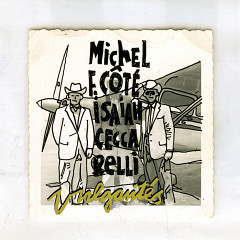
  • Vulgarités dans The Squid’s Ear

    «Review», Dave Madden, The Squid’s Ear, 19 février 2009
    jeudi 19 février 2009 Presse

    As more of a rhetorical, sarcastic ribbing than an actual query, Michel F Côté and Isaiah Ceccarelli write, “What can we do when we’re just two drummers?” Indeed how does a percussion duo entertain an audience for forty-six minutes without a visual aid, balancing all the elements of music into a satisfying listener experience? Côté and Ceccarelli capably do so with a contingent of boundless creativity, astonishing sounds, impeccable performances (both men are accomplished composers and performers who have been around many a Montréal block) and knowing when enough is just enough (the average track length is under four minutes).

    Armed with kits, assorted junk drums, piano, pocket trumpet, “electronics”, feedback and lap steel guitar, Côté and Ceccarelli busily cycle though the history (and future) of percussion techniques. Beginning with “tape” hum and drum head stretches on Surmenage brun, they quietly and anxiously tap on rims, pull adhesives off heads, drag brushes on snares, flick on/off brief mechanical belches and strike every possible angle of their gear. After a brief pause, the duo reworks the first half, replacing some of the acoustics with subtle electronic shadows and closing with a pondering, lugubrious sub-harmonic echo. Moving to a more metal aesthetic, Grâce maussade is a polyrhythmic melee of various Gamelan bells, scraped metals and all manner of prepared keyboard tinkering (string strums, wood knocks, mallet thumps etc.) versus a spacious, lethargic piano melody. Nous, les troglodytes is what would happen if Steve Reid and Kieran Hebden followed through with the direction they hint of on their recent collaborations: hyperactive Interstellar Space style free jazz drumming with a bed of glitching Hammond organ, generated harmonics and DSP keeping pace. Côté and Ceccarelli aren’t simply about assault, however, and they show their range with Las du futur, a tenuous drone formed from oscillating sine waves, melodic feedback, bowed cymbals and intriguing sonic detritus (i.e. wiggling noisy cables), and the chatter-driven, bass drum grumbling, pianissimo Avantage de la débilité.

    Despite John Cage’s work in the 1940s and Edgard Varèse’s Ionisation (1930), the idea of “percussionist as band” is still often treated as a novelty — and, due to the excessive contraptions, toys and otherwise cacophonous instruments employed in most of the repertoire, this is often a fair label. But what happens when this equipment falls into the right hands? The answer is Vulgarités, an album that eschews the word “gimmicky” in favor of “virtuosity”.

    But what happens when this equipment falls into the right hands? The answer is Vulgarités, an album that eschews the word “gimmicky” in favor of “virtuosity”.
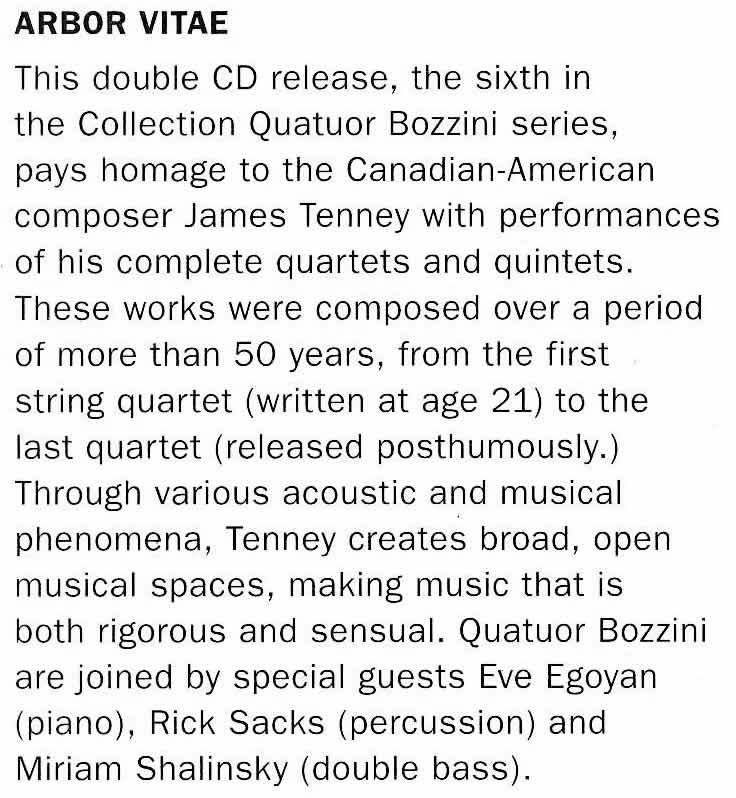
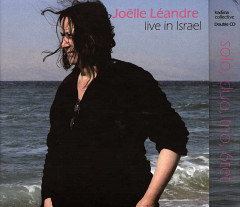
    Live in Israel dans The Squid’s Ear

    «Review», Kurt Gottschalk, The Squid’s Ear, 18 février 2009
    mercredi 18 février 2009 Presse

    Bassist Joëlle Léandre’s solo performances are, without fail, deeply impressive yet enormously human works. She is among that rare class of improvisers — such as Cecil Taylor and Derek Bailey — who are most complete when performing alone (that said, however, Bailey and Léandre’s 1997 duet No Waiting (Potlatch) is essential in both their discographies). There are, however, enough solo records in her catalogue that keeping up can be a challenge. A second selling point, then, is a smart idea.

    Live in Israel offers the best of both: the first CD contains 54 minutes of Léandre unaccompanied from Tel Aviv and the Oud Festival in Jerusalem in 2007. She is, as always, virtuosic, elegant, and resonant. Like Bailey and Taylor, her work is so personal that, to a degree, you know what you’re going to get: the soul laid bare twice is still the same soul. It’s the second half of the set that — while not as strong — provides particular interest. Also recorded in Tel Aviv and Jerusalem, the disc collects duo, trio and sextet performances with Léandre and an assortment of eight Israeli players. There’s a strange mix of slow unfolding and, at times, tentativeness to the disc; the players allow each other room to move, allowing some nice moments of discovery but ultimately making for an uneven (if nicely programmed) listen. The best known names show up in the sextet, with Assif Tsahar on bass clarinet and Daniel Sarid on piano, but the strongest collaboration is in Léandre’s duet with Sameer Makhoul. The dichotomy of strings, bass and oud, and of voices, male and female, isn’t just the best of the encounters here but stands among the more interesting mixing of textures she has put on record.

    The dichotomy of strings, bass and oud, and of voices, male and female, isn’t just the best of the encounters here but stands among the more interesting mixing of textures she has put on record.

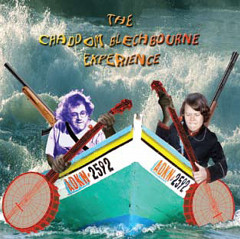
    The Chaddom Blechbourne Experience dans The Squid’s Ear

    «Heard In», Kurt Gottschalk, The Squid’s Ear, 4 février 2009
    mercredi 4 février 2009 Presse

    Eugene Chadbourne’s experiments in country, bluegrass and old-time music have been as diverse in approach as they have in the source material he selects. He’s recorded faithful renditions of banjo instrumentals, outlaw country with top-notch session players and outré Americana experimentalism with some of the best improvisers from around the world. But he has perhaps never found a hoedown partner so ready to match his playfully reverent approach as fellow banjo picker Kevin Blechdom.

    The trouble with playing Appalachian folk (as is the focus on The Chaddom Blechbourne Experience) for avant audiences is that it, perhaps, can come off to some as more out, more ironic, than it really is. The close harmonies and flattened melodies often heard in bluegrass might come off as cheeky to listeners accustomed to hearing such intervals as “dissonant.” But it’s the language of mountain music, just as Eastern scales contain notes that don’t fall within Western notation. The Chaddom/Blechbourne Duo brings that out in ways for the most part surprisingly traditional. Granted neither of them are great singers, and Chadbourne outclasses Blechdom in instrumental prowess, but their takes on Corina Corina, Alabama Jubilee and, nicely, boldly, hilariously, Froggie Went A Courtin’, are pure front-porch soul, and Blechdom’s vocal wail fleshes out quite wonderfully their version of The Johnson Boys, a song that has been in Chadbourne’s banjo book for years.

    Which isn’t to suggest that the album — compiled from 2007 performances at Quebec’s Victoriaville festival and The Stone in New York — is a purely down-home affair. They do placidly lovely versions of two Syd Barrett songs (Astronomy Domine and Chapter 24) and some fantastic real-time mash-ups incorporating The Beach Boys with The Violent Femmes and Mystikal. And the closing Dueling Banjos — which begins with the killing of a cockroach and concludes with the pair killing each other — would have been worthy of Victo’s first DVD release. But even as 52 minutes of audio, this experience ranks as one of Chadbourne’s insect and western best.

    this experience ranks as one of Chadbourne’s insect and western best.

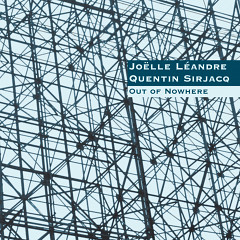
    Out of Nowhere dans Le son du grisli

    «Critique», Grisli, Le son du grisli, 2 février 2009
    lundi 2 février 2009 Presse

    Sans doute, Joëlle Léandre n’a-t-elle pas assez de partenaires illustres, il faut encore qu’elle en révèle: Quentin Sirjacq, ici, jeune pianiste de ses étudiants, avec lequel elle enregistrait récemment Out of Nowhere. Son improvisation, Léandre l’estime alors auprès d’un apprenti en discrétion: suite d’accords pas loin d’être imperceptibles (Ruin) et progressions faussement hésitantes, qui révèlent le goût de Sirjacq pour quelques maîtres classiques (Morton Feldman, plusieurs fois; Erik Satie, sur Hallucinations). Un art de la mesure — quand le pianiste ne se laisse pas emporter par un lyrisme plus entendu — auquel la contrebassiste oppose un archet grainçant, une récréation percussive (Fragment 2) ou un romantisme noir (The Call). De lignes de fuite (Léandre) en points de chute ou de suspension (Sirjacq), Out of Nowhere fait alors son lot de l’instant, autour duquel il pourra longtemps tourner.

    Un art de la mesure […] auquel la contrebassiste oppose un archet grainçant, une récréation percussive (Fragment 2) ou un romantisme noir (The Call).

    Live in Israel dans The Wire

    «Review», Julian Cowley, The Wire, no 300, 1 février 2009
    dimanche 1 février 2009 Presse
    I recommend it unreservedly for the set of seven solos, which contains some of the most eloquent and affecting music Léandre has committed to disc.
  • 25
  • 26
  • 27
  • 28
  • 29
  • 30
  • 31
  • 32
  • 33