Sauter au contenu principal
actuellecd

Blogue

3585 résultats
  • 461
  • 462
  • 463
  • 464
  • 465
  • 466
  • 467
  • 468
  • 469
  • liberum arbitrium, morceaux_de_machines dans Sonoloco Record Reviews

    «Review», Ingvar Loco Nordin, Sonoloco Record Reviews, 25 novembre 2002
    lundi 25 novembre 2002 Presse

    These laptop goblins make sure nothing is really sure anymore, as they bring the fuzzy principles of quantum mechanics and string theory into the world of binary sonics, played backwards in time, it seems, to the beat of sprawling chronometer meltdowns, clocks and spiders crawling away across cracks in the cement, time bent in on itself, curving ever deeper into spirit and matter, ever closer to the core of the NOW, as the minute, minuscule slices of time with their minute – but densely packed – fragments of lives are mangled through a wormhole in space-time with a Gargantuan might that distorts everything recognizable and well-known into pointillist approximations of an echo of the solid, bohemian safety of A Prairie Home Companion… individual remains of human lingual morphemes floating up into conscience in flaky dandruff residue – and I’m talking about music, don’t you forget, music right above the surface of dirty blue jeans and shimmering Macintosh interfaces, out of frantic, warm circuits in a mystery machine right out of The Hitchhiker’s Guide to the Galaxy – but DON’T PANIC!!!

    The Quebec City radio show Napalm Jazz on CKIA–FM back in the mid 1990s constitutes the beginnings of the duo work of Aimé Dontigny and Érick d’Orion. The concept of the show was a wild mix of avant-garde, hip-hop, free jazz, electronics, found sounds and musics, which lays down the direction of the subversive workings of these guys up until this today, obviously providing enough creative force to keep them staggering down this wildman path!

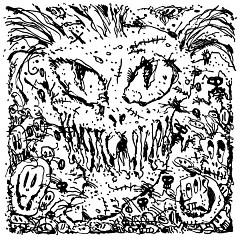
    The packaging is something extra here. It is made like regular empreintes DIGITALes covers, with a contraption of fold-out, hard, high-quality paper, but the art is overflowing and really compelling here, with demonic drawings by cartoonist Guy Boutin and wonderful water colors by Sophie Dowse. The whole impression of this package is one of bursting, overflowing, overpowering creativity. Flow with it or bend out of the way and hide, until it sweeps by!

    In track 2 I actually find a more overarching, modal structure, in a bubbling frenzy which the mind glues together into a bead, a line, a melody of sorts, if only from a distance, as fractions of voices add a human touch, and the static of telephone lines through minus 40 Lapland wastelands wheeze and crackle through the human predicament with needy messages for a hungry ear beyond the weather…

    There is nowhere to hide from this army of lightning rods inside your head, emerging from the core of Self, cutting away at your stray thoughts like a battalion of paper shredders in an office high-rise. Piano bar melodies are smeared all over the walls, as something gets back at something for something. We slide up against the back wall, easing sideways past the most awesome of goings-on, as the fish jump in frenzied electrocution in their center room aquarium, seconds before impact, as the avenger comes flying in, bent on avenging the 2nd, 3rd and 4th world, as he recognizes “the disgusting thing that causes desolation standing in a holy place” [Daniel 12:11 & Matthew 24:15], and Armageddon is on…

    Track 3 brings hallucinatory voices into a woman’s warmth and shelter (Twas in another lifetime, one of toil and blood, when blackness was a virtue and the road was full of mud, I came in from the wilderness, a creature void of form; ‘Come in,’ she said, ‘I’ll give you shelter from the storm’ [Bob Dylan]) as skin peels descend like soot-flakes from an arson epidemic all across the parking lot as you run and keep on running, away, away, away…

    I get the idea that these sounds may be what alien civilizations on forlorn worlds out of thinkable reach may one day find as the electromagnetic remains of our moment in time on Earth, the distorted transmissions from a died-down culture, a faded-away species, soar past their receivers scanning their cold skies for traces of spiritual spurs down the galaxy clusters and beyond…

    morceaux_de_machines is a virtual dream machine, injecting the listener with such a wild array of visions that peyote and mescaline becomes futile accessories. Aimé Dontigny and Érick d’Orion have found a modern, high-tech backdoor into age-old shaman rites and magic otherworldly experiences – which goes to show that each time in history has it’s on way of boring into the layers of consciousness, towards pre-intellectual domains of bliss and wonder. When genuine and authentic medicine men of contemporeana (for example lap top wizards) take on this feat as seriously as morceaux_de_machines, the means are there, installed, up and running, for anyone with a clear ear to utilize – and I do, with the pleasure of a whooopeee mind rider!

    morceaux_de_machines is a virtual dream machine, injecting the listener with such a wild array of visions that peyote and mescaline becomes futile accessories.

    La spirale de l’escargot dans La Presse

    «Critique», Alain Brunet, La Presse, 23 novembre 2002
    samedi 23 novembre 2002 Presse

    Manouche, klezmer, jazz… dans les règles de l’art!

    Dans la foulée des expériences néo-manouches, néo-gitanes, néo-klezmer et autres amalgames croisant entre jazz et folklores européens marqués par l’Orient (et qui séduisent nombre de mélomanes québécois depuis quelques années), Ipso Facto révèle un noyau intéressant de musiciens qui lorgnent aussi le bluegrass intello. Sous la gouverne du guitariste et compositeur David Bussières (frérot de la célébrissime Pascale) qui travaille avec la violoniste Chantal Bergeron depuis l’époque où ils étudiaient ensemble à Vincent d’Indy, ce quatuor comprend aussi le contrebassiste Simon Dolan et le percussionniste Francis Roberge. Du bon travail, un coefficient de difficulté plutôt élevé, mais des compositions qui ont tout de l’exercice de style vu la mi-vingtaine de celui qui les signe. Dans les règles de l’art, en somme.

    La spirale de l’escargot, Ipso Facto dans Splendid E-Zine

    «Review», George Zahora, Splendid E-Zine, 22 novembre 2002
    vendredi 22 novembre 2002 Presse

    Hot damn! After digging through what seems like a thousand discs of half-hearted indie-rock blandness, I’ve found some gypsy improv jazz.

    Ipso Facto, part of the fledgling (I believe) Monsieur Fauteux, m’entendez-vous? street musician collective, are apparently authentic Quebec gypsies. I can’t honestly claim to know what this signifies; for all I know, they live in wooden caravans parked on the darkened backstreets of Montréal as opposed to, say, shacking up in a big old polluted loft space with eight of their closest friends. It doesn’t matter. The quartet’s music — a jaunty, sometimes ribald mix of violin, acoustic guitar, contrabass and percussion — sounds like classic gypsy tunes, rooted in the rich mystery and wanderlust of Eastern European musical tradition, but also channels the passion and uncertainty of modern exploratory jazz.

    Prohibition-era hot jazz borrowed liberally from gypsy and Jewish music, particularly its use of violin as primary “voice”. Ipso Facto compresses all of those approaches into a single aesthetic. Violinist Chantal Bergeron is the group’s driving force, and her instrument defines each song’s emotional standpoint: she pushes Attention Zingaro in a rollicking and dangerous direction, fills Yiddish Meshugass with a dark and mildly mocking air of mystery, empowers Soleil Rouge’s mournful tango, helps to bring Voltapük to a jazzy boil and heads down south for the country swing of Crazy Cowboys. And let’s not forget Kosmos Klezmer, in which Bergeron’s violin functions as a time-honored stand-in for the traditional clarinet.

    Guitarist David Bussières connects Bergeron’s dots — which, on album, relegates him to something of a secondary role. That’s ironic, given that he wrote all but one of these pieces (Y fait frette à Madrid, for which Bergeron shares credit). Bussières picks and plucks his way around the fretboard rather than sloshing through endless barre chords, but his nimbled-fingered performance, which owes more to classical guitar compositions and certain noodly-guitar-intensive strains of jazz than rock ’n roll, is initially overshadowed by the violin. On a few tracks, his work stands out immediately — see the mournful Alchimie and the gloriously twisting Kosmos Klezmer; elsewhere, his details will only be revealed over the course of repeat listens.

    Simon Dolan (bass) and Francis Roberge (percussion), as the rhythm section, have significant control over the group’s direction. Dolan’s steadfast, thrumming rhythms ride herd on every tempo; hear him hold Yiddish Meshugass in syncopated check, slow L’Affaire Mendoza to a distraught crawl, and spur Crazy Cowboys onward in a jazzy two-step. Roberge, meanwhile, is the group’s stylistic anchor, pinning each tune to a specific mood. Through Roberge, Yiddish Meshugass acquires its endearing woodblock rhythm, Kosmos Klezmer gains the brush-, shaker-, bongo- and tambourine-driven electricity of a free jazz workout, and Voltapük careens jazzily (and a bit disjointedly) through a grab-bag of percussion concepts.

    There’s a flaw here, but it’s unavoidable. Simply by committing their music to tape, Ipso Facto rob themselves of much of the unpredictability that must be unleashed, full force, during their live performances. That also means that La spirale de l’escargot isn’t as “improvisational” as it could be; each of the disc’s twelve pieces allows room for the quartet to stretch, but their explorations seem fairly structured as a matter of necessity. We’re therefore spared the sometimes painful moments, amply documented on a few of parent label DAME’s more envelope-pushing releases, in which group members stretch for a sonic convergence that’s clearly beyond their reach — but we’re also denied the truly transcendent serendipity of an eight-minute jam session in which everything clicks. Fair enough; this is Ipso Facto’s first album, and they’ve done a laudable job of capturing the spirit of their hybridized gypsy jazz. Don’t be surprised, however, if after a few listens, you’re dying to see the group play around a forest campfire — as free from rules, obligations and limitations as they gypsies whose blood they claim to share.

    … they’ve done a laudable job of capturing the spirit of their hybridized gypsy jazz.

    Les Poules, Ambiances Magnétiques dans AllMusic

    «Portrait: Les Poules», François Couture, AllMusic, 21 novembre 2002
    jeudi 21 novembre 2002 Presse

    Les Poules began as a side project for Joane Hétu (vocals, sax), Diane Labrosse (keyboards) and Danielle Palardy Roger (drums), three members of the feminist collective Wondeur Brass. The release of their first LP in 1986 cemented the relationships and the musical approach of this trio: a partly improvised form of synthetic avant-pop. The members went on to participate in many other projects. In 2000 the trio itself was resurrected as a free improv unit and a new CD came out in 2002.

    The year is 1986, the location Montréal. A group of avant-rock feminists has been active for a few years under the name Wondeur Brass. Started as a political music theatre, it has evolved into a provoking experimental pop group. At that point Hétu, Labrosse and Roger, the three most avant-gardist elements of the collective, felt the need to retract from the large ensemble (which has counted as many as nine members at one point) to work on their own small-scale project, christened Les Poules — “the chicks,” a bitter name for feminists. The music on Les contes de l’amère loi, released in 1986, shows a sharper focus than Wondeur Brass’ Ravir (1985): post-new-wave in spirit, cold and chaotic, the songs left more room to improvisation and yet packed more punch. Instead of bringing back the other members of WB, on hiatus, the trio decided to sack them and hire bassist Marie Trudeau. This quartet recorded Simoneda, Reine des esclaves under the moniker Wondeur Brass before switching to Justine and releasing two more albums in the 1990s. Hétu, Labrosse and Roger continued to work on each other’s solo projects and co-run the production company SuperMusique, but everyone believed Les Poules was a project of the past.

    In 2000, Hétu, Labrosse and Roger performed in Victoria and Vancouver (Canada) as a trio again and the use of their old group name came naturally. A year later, Ambiances Magnétiques reissued Les contes de l’amère loi on CD and the trio presented a concert in Montréal. No nostalgia is involved, the old repertoire has been buried. The new Poules play quiet free improvisation. Lyrics have devolved into abstract vocalizations, the keyboard licks have become treated samples, the beats have turned into textural percussion work. Prairie Orange came out in 2002.

    Lyrics have devolved into abstract vocalizations, the keyboard licks have become treated samples, the beats have turned into textural percussion work.

    Twenty Quarter Inch Jacks dans Voir

    «Disques», Réjean Beaucage, Voir, 21 novembre 2002
    jeudi 21 novembre 2002 Presse

    La pièce-titre est une composition pour un chœur de 20 guitares électriques (toutes jouées par Brady ici) et passe en revue les possibilités de l’instrument, du son le plus propre au plus fuzzé et de la mélodie la plus douce au heavy métal. Commandée par le festival Les Coups de Théâtre pour être interprétée par 20 élèves d’écoles secondaires, on pourrait s’attendre à ce que cette musique soit simpliste: or, il n’en est rien et il faudra entendre ça en concert (création le 20 novembre à 21 h à l’espace chorégraphique Jean-Pienre Perreault pour voir si le compositeur n’a pas surestimé ses musiciens! Aussi sur ce disque, une commande de l’Ina-GRM et une autre du Centre for Contemporary Arts de Glasgow, toutes deux pour guitare et bande, où Brady explore avec bonheur l’espace sonore électroacoustique.

    Brady explore avec bonheur l’espace sonore électroacoustique.

    Twenty Quarter Inch Jacks dans AllMusic

    «Review», François Couture, AllMusic, 21 novembre 2002
    jeudi 21 novembre 2002 Presse

    After releasing a pile of albums on the Montréal jazz label Justin Time, which despite its progressive outlook on the genre was always a little overwhelmed by the experimental nature of his productions, Tim Brady delivered in 20 Quarter Inch Jacks his first CD for Ambiances Magnétiques. And a good one it is, ironically lighter than some of his previous recordings yet still challenging and charged with that special Brady-esque guitar humor. The disc contains three new works. First up is the thundering title track, a suite in eight parts running for a total of 30 minutes. Written for 20 electric guitar players (all parts performed by Brady on this recording, but it has been played live with an ensemble), the piece attempts to run through the history of the instrument in a whimsical setting of narrator-and-examples. Movement titles like Metal, Waves, Harmonic Fields or Big Chords are as programmatic as can be. In the Opening, a multi-tracked Brady introduces the notes strummed one by one, à la Viv Stanshall in Mike Oldfield’s Tubular Bells. Taken as a whole the piece presents intricate arrangements, some crunchy playing and good-hearted fun. It could be reasonably deemed too light by some detractors. The sixth part, An Alphabet of Guitarists, is exactly that: Brady calls the name of one guitarist per letter of the alphabet over a group riff left unchanged by these invocations. Its purpose remains uncertain and its presence questionable (guitar fans may also want to debate the composer’s choices). This long piece should not overshadow the presence of Music Box Bell Curves (Hello Paris!), a stunning 14 minutes of electroacoustic music combining wailing guitars, powerful sample treatments and martial rhythms reminiscent of Art Zoyd. The closing Sauchiehall Street is a piece for guitar and tape moving from atmospheric playing to frenzied soloing and back.

  • 461
  • 462
  • 463
  • 464
  • 465
  • 466
  • 467
  • 468
  • 469