
Riel, Plaidoyer musical / Musical Plea
Normand Guilbeault
Guilbeault’s musical style owes a great deal to jazz, and I noticed more than a fleeting similarity to Mingus. […] a finely crafted musical drama. — Splendid E-Zine, USA
Recommandé. — CFLX 95.5 FM, Québec
On the eve of the 114th anniversary of the hanging of the Franco-Manitoban Métis leader Louis Riel in Regina on 16 November 1885, double bass player Normand Guilbeault is launching his 2-CD work entitled Riel, Plaidoyer musical / Musical Plea, recorded in February at the Lion d’Or in Montréal.
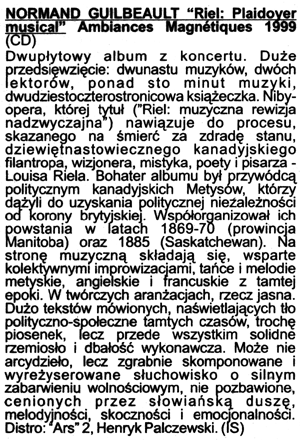
The result of four years of diligent research, Riel, Plaidoyer musical / Musical Plea sheds new light on one of the little-known and most controversial episodes in Canadian history.
Accompanying the discs is a 72-page booklet that includes archival photographs of the period and texts, in English and French, by Louis Riel, Gabriel Dumont, commander of the Métis forces, Louis Schmidt, principal secretary to Riel, and Père André, who ministered to Riel during his last night.
With Riel, Plaidoyer musical / Musical Plea, Normand Guilbeault and his large group of outstanding musicians invite us to discover a historical and musical epic set on the Manitoban frontier. Original compositions, native chants, gigues, reels, songs of the period, military marches and improvisation are woven to create the fabric of a vibrant work that combines politics and poetry. Music, chants, political texts and poetry surprise, delight and assert without compromise.
- Composer(s): Normand Guilbeault
- Performer(s): Lou Babin, Matthieu Bélanger, Jean Derome, François Gourd, Ivanhoe Jolicœur, Claude Lavergne, Paul Léger, Bob Olivier, Sylvain Provost, Jean René, Pierre Tanguay, Marc Villemure, Tom Walsh
- Cover image: Luc Beauchemin
- Graphic design: Luc Beauchemin, Jean-François Denis
Download (AM 073_NUM, 1999)
- This item can be downloaded and/or listened to at ambiances-magnetiques.bandcamp.com.
- 1Nous sommes métis, 5:08
- 2Thomas Scott, 3:47
- 3
- 4
- 5L’avis à McDougall, 4:35
- 6
- 7La prise du Fort Garry, 7:21
- 8
- 9Fort Schultz, 2:48
- 10
- 11
- 12Riel monte à l’échafaud, 2:47
- 13Hymne à Louis Riel, 6:05
- 14
- 15L’exil, 10:58
- 16
- 17L’exovidat, 4:06
- 18
- 19
- 20Batoche, 6:00
- 21Le procès, 8:51
- Label: Ambiances Magnétiques
- AM 073_NUM
- 1999
- UCC 771028107384
- Total duration: 105:05
Some recommended items


In the press
Critique
Jusqu’à aujourd’hui, le nom de Louis Riel m’était tolalement inconnu. Le contrebassiste Norman Guilbeault a choisi de réhabiliter ce poète, écrivain, chef politique, défenseur des Métis canadiens et héros national. Me méfiant comme de la peste de ces derniers, on peut se demander qui était vraiment ce Monsieur Riel. Poète
Review
Review
Let me state from the outset that I’m no expert on Canadian history
Guilbeault’s musical style owes a great deal to jazz, and I noticed more than a fleeting similarity to Mingus. Like Mingus’ more ambitious compositions, Musical Plea is at once innocent and world-stained, joyous and tragic. Sometimes it lurches along, while at other times it soars. Its substance consists of American Indian chants, gigues, reels, military marches and anthems woven together with long threads of improvisatory material. This interplay between the historical and spontaneous results in a kind of souped-up snapshot of the past — as if documentary and commentary had become one. The dramatic climax of the work comes as Louis Riel is hanged for treason, and the music comes abruptly to a halt with narration in mid-sentence. The effect is chilling indeed
Review
A monumental undertaking requiring four years of research, Montréal bassist/composer Normand Guilbeault’s Riel debuted at Victoriaville in 1998 and played again at the Lion d’Or in February 1999, where it was recorded. Packaged beautifully, with an informative 72-page booklet, this is top shelf all around. A large cast of Montréal’s best musicians Jean Derome, Pierre Tanguay, Tom Walsh, Jean René, Mathieu Bélanger, Bob Olivier and others) tells the story of the doomed and damned Metis leader, mixing Scottish and French reels and jigs, native and Metis songs, Orangemen chants, and improvisations in a passionate tour de force that is stimulating both as musical event and history lesson. 4/5
Délire actuel: Critique
La pendaison de Louis Riel par les autorités canadiennes à la fin du XIXe siècle raisonne encore dans l’imaginaire collectif québécois. Le contrebassiste Normand Guilbeault offre avec Riel
Soundcheck Review
Louis Riel (1844-1885) is one of the most controversial figures in Canadian history, regarded by some as a hero, by others, a traitor. In January 1869 the Hudson Bay Company sold most of its land in the north-west to the Canadian government without regard for the territorial rights of the resident, French-speaking, half-breed Métis, who appealed to the well-educated Métis, Louis Riel, to lead them in their struggle. As secretary of the Métis movement, Riel organised blockades against government surveyors and was instrumental in the formation of a provisional government for the Métis of which he became president. The problem soon escalated into armed conflict. Normand Guilbeault’s Riel/Musical Plea dramatises these Métis uprisings in Manitoba (1869-70) and Saskatchewan (1885), culminating in the trial and execution of Riel in 1885. Guilbeault’s position is pro-Riel and he offers this nearly two-hour work as a “fair tribute to this national hero, unjustly accused of high treason.”
A patchwork of styles, including rousing native chants, French-Canadian songs, military marching themes, jazz and free improvisation, Riel appears, on first hearing, an uneven experience, though greater familiarity with Guilbeault’s polystylistic method reveals a work of considerable emotional power, rooted in the musical landscape of Riel’s time. Narrators (in English and French) speak for the principal participants in the action
Critique
Le combat de Louis Riel pour son peuple aux sangs mêlés demeure l’un des plus spectaculaires de l’histoire canadienne. Le contrebassite Normand Guilbeault s’est pris de passion pour ce chapitre déterminant, ce qui l’a conduit à imaginer une musique résolument métisse. Ainsi, il s’est inspiré de chants autochtones, de rigodons francophones ou autres formes populaires résolument américaines qu’il a injectés dans son jazz contemporain. Il s’agit là de la plus vibrante et plus accomplie des musiques jamais composées par Guilbeault mais… comme je l’avais noté Iors de la création de Riel (en mai 1998 au festival de Victo, le livret de ce
Critique
Normand Guilbeault, contrebassiste et compositeur, a commencé à travailler sur ce que l’on a longtemps appelé le
8,5/10
Blog
- Monday, November 30, 2020 / New releases
Several of our older titles are no longer available in physical format, and we are pleased to announce that those albums are now available as download
! Locomotive Je me souviens — Hommage à Georges Perec; Tu r’luttes Riel, Plaidoyer musical / Musical Plea 1. Grrr 2. Tok 3. Ahhh {cat:am_17… More - Monday, November 30, 2020 / New releases
- Nébuleuses by Beta Lyræ
- Visions fugitives op. 22 by Quartetski
- Plat by Fenaison
- 4. Hmmm by Martin Tétreault, Otomo Yoshihide
- 3. Ahhh by Martin Tétreault, Otomo Yoshihide
- 2. Tok by Martin Tétreault, Otomo Yoshihide
- 1. Grrr by Martin Tétreault, Otomo Yoshihide
- Riel, Plaidoyer musical / Musical Plea by Normand Guilbeault
- Je me souviens — Hommage à Georges Perec
; Tu r’luttes by Jean Derome - Locomotive by Locomotive
- Thursday, March 20, 2003 / New releases
Inspired by Normand Guilbeault’s Riel, Plaidoyer musical / Musical Plea, filmmaker Sylvie van Brabant has directed the documentary Sur les traces de Riel. Normand Guilbeault and Rose Fleury (a 75-year old Metis) travel to Batoche in Saskatchewan in swearch of the genuine hi… More