Tim Brady is very comfortable in his two hats. On one side of his head sits his electric guitarist fez, emblazoned with colourful emblems showing his affiliation with various rock and jazz schools, and manufacturers of electronica. On the other side perches his composer cap, of a trifle more scholarly cut, you will notice, but worn nonetheless at a rakish angle. The brain inside the head that these hats adorn has been responsible for a sizable number of recordings over the past few years, more or less equally divided between the “composer” and “guitarist” hemispheres. Two recent releases on Ambiances Magnétiques continue this trend.
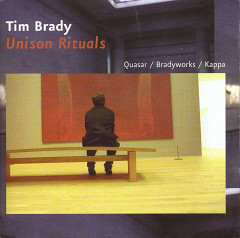
Unison Rituals brings together five Brady compositions spanning fifteen years. Each work carries Brady’s compositional trademark: sinuous, rapid-flowing melodic lines, syncopated yet utterly fluid, given precise unison voice by the participating musicians in what can only be described as a form of ritual — virtuosic, technically dazzling, and demanding a Zen-like detachment. All but one of these performances are guitar-free.
At the core of the album are the three most recent pieces, all dating from the mid-1990s and all performed by permutations of the Bradyworks ensemble. Double Helix initially bears more than a passing resemblance to Doubling from Brady’s album 10 Collaborations. But where the latter maintained a single and single-minded melodic thread throughout, Double Helix grows a second strand and then lets the two curl sensuously and organically around each other. In Two Chords Less Than a Blues, three musicians -— pianist, percussionist, saxophonist —- circle each other warily like competing wolves, mingling menacing growls with bravura displays of aggression as they stake out their individual sonic turf. Gradually, they learn to co-exist and the tension and energy drain perceptibly away. But before long their insipid alliance crumbles and frenzied animalism returns. Escapement, by way of contrast, is a work on an entirely human scale, where Brady’s own retuned guitar —- in its sole appearance on the album—provides a backbone upon which the other instruments (percussion, cello, soprano saxophone) drape muscles, tendons, thoughts, dreams, emotions. Here, unison is achieved in commonality of spirit and the results are literally ecstatic.
Bracketing this trio of Brady works performances are two older works. Unison Rituals (1991) as rendered by the saxophone quartet, Quasar, is by turns stridently frenzied and delicately reflective. Quasar handles the difficult extremes with aplomb. Less affecting is the concluding Sound Off, a 1983 composition designed, according to the notes, “to be played in an outdoor, urban environment.” The drastically scaled-down version here (thirteen minutes rather than forty-five; forty two musicians rather than 108) is nevertheless hopelessly out-of-scale to the rest of the finely turned album, although the performance, by brass and percussion ensemble Kappa, is committed.
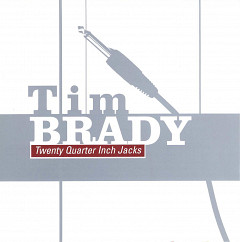
For Twenty Quarter lnch Jacks, Brady reclaims his guitarist hat with a joyful vengeance. (The composer cap is still on his head, but noticeably askew.) The title selection is an eight-movement homage to the six-stringed beast, or rather, twenty of the things (see article Twenty Quarter Inch Jacks in Musicworks 85). Originally composed for and performed by a group of student guitarists, this version has Brady supplying all of the voices himself through the wonders of multi-track recording. His own physical voice provides occasional commentary and intones an alphabetical honour roll of guitar greats. The music pays homage to Steve Reich’s seminal 1987 work, Electric Counterpoint, yet is uniquely and compellingly Brady. Musk Box Bell Curves, (Hello Paris…), and Sauchiehall Street are scored for guitar and tape, and Brady manipulates the elements of each piece into a seamless whole. The former offers moments of transcendental beauty amid studied washes of sonic colour, although I find occasional vocal injections (Hello Paris…) to be intrusive at best. More eloquent is Sauchiehall Street, which captures Brady doing what he does best: creating vivid, imaginative soundscapes into which his own fluent guitarisms blend effortlessly.
Fans of Tim Brady’s guitar work may enjoy Twenty Quarter Inch Jacks, but others might be wise to start with his earlier Justin Time releases Scenarios, Imaginary Guitars, and Strange Attractors.

![Nous perçons les oreilles / Aussi sur la photo: Jean Derome, Joane Hétu [Photo: Romuald Che, Montréal (Québec), 21 janvier 2018]](https://res.electrocd.com/image.php/image/n/nousperconslesoreill_.8991.jpg?width=n2&cropratio=1:1)