Unison Rituals dans Downbeat
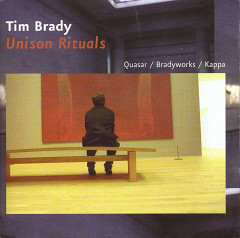
If Twenty Quarter-Inch Jacks is a guitarist’s paradise, Unison Rituals is as unique for the fact that
The sole guitar feature, the atmospheric Escapement, illustrates what an effective player

If Twenty Quarter-Inch Jacks is a guitarist’s paradise, Unison Rituals is as unique for the fact that
The sole guitar feature, the atmospheric Escapement, illustrates what an effective player
[…] Speaking of the No Type-ers… After what has been some public critique of Mutek, even on this list, No Type presented a label showcase at the Studio yesterday that enraptured the crowd, sucking them into a vortex of noise and improv electronic performances. […] No Type held attention despite the soundsystem’s relatively quiet range, with Samiland travelling a wealth of minimalist and dub territories, from sparse and deep broken beats to ambience, leading into the madness that was to follow
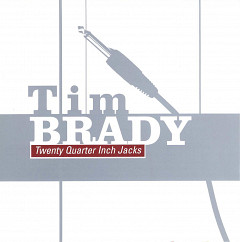
On one movement of his suite Twenty Quarter-Inch Jacks,
The title suite is a guitarist’s fantasy— composed for 20 players, but performed here solely by
Une rencontre symbolique entre deux générations de créateurs,
À son retour du 20e FIMAV, où il participait à l’un des rares concerts qui ont suscité une belle unanimité, Martin Tétreault s’attelait à la tâche de préparer 500 nouvelles copies de ce coffret de 3 mini-CD tout juste paru chez Ambiances Magnétiques. Avec son comparse Yoshihide, Tétreault a d’abord enregistré une séance live au New 28 Studio, en France, dont certains extraits forment le premier disque. Repartis chacun de leur côté avec les bouts non utilisés pour ce premier mini-CD, Tétreault a produit un montage sur magétophone et Yoshihide sur ordinateur. On est ici dans le ronflement de la lutherie
For once I have split the label reviews — there are two other No Types in here — because of the variety. Recap the story — web label (with host of wonderful free music) mentioned often times in &etc went ’real’ last year in conjunction with DIFFUSION i MéDIA (purveyors of the empreintes DIGITALes electroacoustic label, also seen across the issues, most recently the last). The first batch of releases were reviewed here (2002_3, 7 and 8), and now we see the next fruits.
The first release (number 1&2) was the double compilation ’Freest of Radicals’ that introduced us to some of the people featured on the ’web — but with new tracks. In an even more extensive production, here we are presented with four studio albums from improv groups representative of the new sound of Montréal, particularly centring on the Casa del Popolo, featuring a slightly overlapping membership. So into it.
First, this is improvised free jazz — furious, complex, intricate, dense and frenzied. To buy it you would have to be interested in the music — 220 minutes is not for the faint hearted. I find that I listen to it somewhat like the music — in bursts. And in the right mood — my first encounter with Po was fairly negative as I was a bit tense — not relaxing music. And finally it is also hard to describe — so these reviews will be more overviews rather than the usual detailed description. I will also work through in a non-sequential order on the basis of accessibility (to me).
The Trio is Chris Burns, Nicolas Caloia and John Heward on guitar, bass and drums, and that more traditional lineup delivers the most accessible album. While the instruments are all given fairly equal value in the mix, the guitar predominates, probably because you can do more with it in sonic terms — even more as we’ll see on the other albums. The first six tracks, titled ’Presence #X’ are relatively short, between 3 to 8 minutes, shift through relaxed twangy guitar and a solo in #1, through the faster #2 with some sliding-ping guitar, to the bass driven #3 in which the instruments gradually coalesce but remain tentative. Strange creaks twangs and scratches on #4 develops a western guitar and buzzy bass, while #5 opens with a melodic guitar/bass set, becoming scratchy and edgy before a short drum solo that presages a more extended solo in #6 with light bass and guitar behind out of which some bendy guitar builds. The final track is a more extended 20 minutes and sees the group work through moods which have been presented individually in the shorter pieces, building from a very soft scrape through some buzzing to a drum pushed noise guitar solo, dropping to a brief drum solo joined by restrained guitar and bass, then almost silence before another gradual development to a shimmeringly percussive climax then fading. The instrumentation is well balanced and the approach never gets too harsh on this disk which makes it the easiest listening — though none are easy.
Next to Belan Mecanique, the superest-group here — six members on sax, trombone, bass, keyboards, guitar and drums. This was my second choice — I initially had favourite, but this set is too diverse for favourites — because while the size of the group tends for a full explosive sound, the diversity of instrumentation provides a broad sound palette which offers the most variation. The group offer a mixture of three short pieces — basically 1 or 2 minute full on aural explosions, and four much longer pieces which allow them to explore their dynamic. The tracks tend to be precipitous rolling sound works where each member is driving away, separately but somehow providing some cohesion, easing back at times. The ear either picks out particular instruments or the engineers place people at different places in the mix at different times. ’Gypt Gore use the idea of action painting in one of their titles, but it works for this too. ’Les elephants n’oublient jamais’ for instance turns through fast honking sax with drums and sliding trombone added, keyboards whizz almost sci fi. A quieter period before the drifting vortex gets bigger and bigger, easing to allow the piano to be heard, then the trombone moves forward, gtr sax and xylophone into a restrained minimal section, piano sax and rim drums swinging in to a soft end. There is a mysterious mood throughout ’Rouages’ that builds to a choppy quacking centre before drifting back to a lighter touch via some descending guitar and trombone laughter. Some more ambient periods (in relative terms) through ’Brule-pourpoint’ emphasise the range that the group can work in while the final ’Racines’ has some nice sax swing and even beer house piano. While there is more democracy in this group, the wind instruments probably are more distinct in the wall of sound with the guitar playing a more supportive role. The keyboards — which include some electronica — provide interesting shading while the rhythm section keeps things moving. The dynamism seen here, and the variations, make this disk very re-approachable.
’Gypt Gore is primarily Philemon (sax) and Sam Shalabi (guitar) who were also in Balai. They carry the energy from that group, but the music is constrained by the instrumentation. The music is exciting — they are like a perpetual motion machine as the sax blows wildly and the guitar picks and plays short fast and furious. Luckily there are periods where the playing is slower or more restrained — the slow and sensuous opening to ’Flakes’ for example or ’Narcoma action painting’ which has the speed but seems somehow more relaxed. On a couple of tracks Thierry Amar (bass on Balai) joins and the playing becomes more relaxed
Po present seven ’Provocative Operations’ that combine drums, two guitars (including prepared) and double bass in what was for me the most difficult album. It may be that the instruments have been most removed from their ’natural’ sounds here making it more demanding or the more oblique attacks. It opens with brief warming up before a bubbling machine of sound — scrapey guitar mumbles as the music drives on, and there appears to be some bowing as the music get quieter. In the second part scratching and squeaks with a slow percussion, sounds like violin and piano, building puttery, then ringing prepared guitar, strong bass stepping, a sort of static momentum of sound
This is a daring product for No Type to come out with — people who know the Montréal scene will be drawn to it, but in the wider world there may be more uncertainty. While I wouldn’t recommend this to everyone (in fact I wouldn’t for most things I review — we all have such different tastes and preferences) I would suggest that people who are interested in improvised music, tending to the jazz end, seriously consider it whether as an introduction to the form or an addition to their collection. I enjoyed these disks more than I thought I would — improv is an area I am developing my listening skills in. The variety between and within the performances means that there is much that will interest most people, and it offers a great opportunity (at a good price) to listen to some mainly intense music (though there is some light and shade which allow you to recover) which may stretch your expectations, and should definitely excite you.
(I don’t generally do this, but I looked on site and this set costs $40 (can) and had a 10